Join us in Cannes for our Institutional Conference on March 31st



Davos, Macro Drivers & Crypto Implications
The World Economic Forum (WEF) in Davos, held from January 19 to 23, 2026, was dominated by the Trump factor and, more broadly, by the resurgence of a highly political use of economic tools. The most striking point was the threat of new U.S. tariffs targeting several European countries in the context of tensions surrounding Greenland, before adjustments were made following discussions with NATO partners. This episode revived the idea that trade barriers can be used as a geopolitical lever, and not just an economic one.
The rules of the game have changed for international trade, and there could have been no better opportunity than the Davos forum to highlight this. As the Canadian Prime Minister Mark Carney stated, “we are in the midst of a rupture, not a transition”, which implies that countries must rethink how they trade and, above all, reassess their trading partners within a complex geopolitical context.
For Europe, this forum initially emphasized the need to accelerate decision-making and response capabilities, as well as to accelerate diversification strategies in light of trade, energy, technological, and security dependencies, given a transatlantic relationship deemed less predictable. In the background, discussions also highlighted a more volatile macroeconomic environment due to the risk of trade fragmentation and political uncertainties.
What is particularly important to note is that Europe is positioning itself by emphasizing predictability. It clearly states its intentions, operates within relatively transparent frameworks and timelines, and seeks to reduce uncertainty for economic and political actors. Conversely, the United States favors a more tactical approach, revealing its intentions only belatedly. This tactic, sometimes used as a bargaining chip, frequently creates an element of surprise and forces both partners and competitors to adapt urgently.
The geopolitical and economic uncertainties generated by the statements made during this week’s forum in Davos have had a significant impact on the markets, where various asset classes have experienced increased volatility after a downward trend in recent months.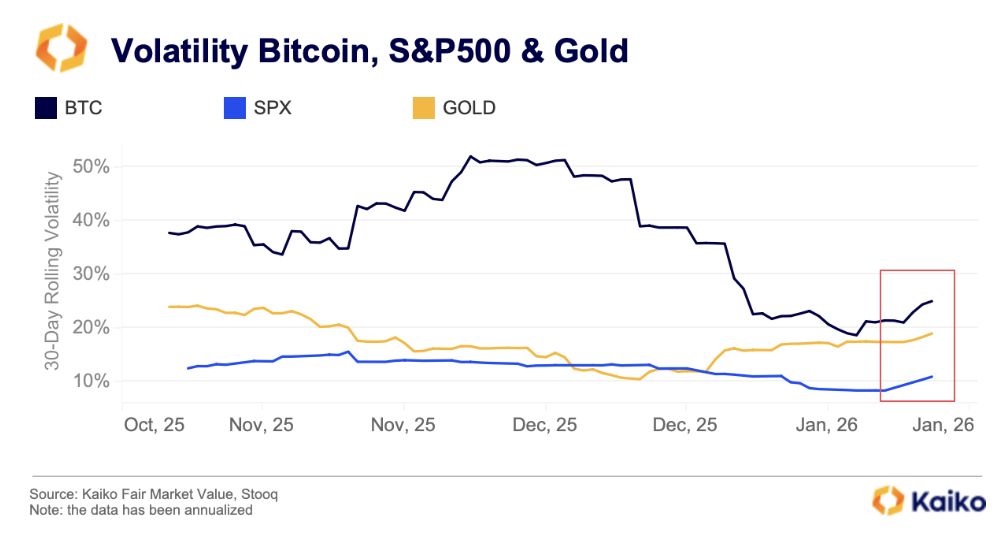
Crypto Markets
Regarding cryptocurrencies, the focus was clearly more on infrastructure than on speculation. The discussions revolved around stablecoins, asset tokenization, and gradual integration by financial institutions to meet real and growing demand. At the Davos forum, crypto was treated as a technological layer becoming normalized through regulation and institutional adoption, rather than as a purely risk-on issue.
The forum revealed a growing convergence between banks adopting blockchain infrastructure and blockchains evolving to meet institutional needs. This convergence has been made possible by the development of a regulatory framework for cryptocurrencies, but also because banks can no longer ignore demand. The widespread use of stablecoins establishes them as a credible payment method, and tokenization offers faster execution.
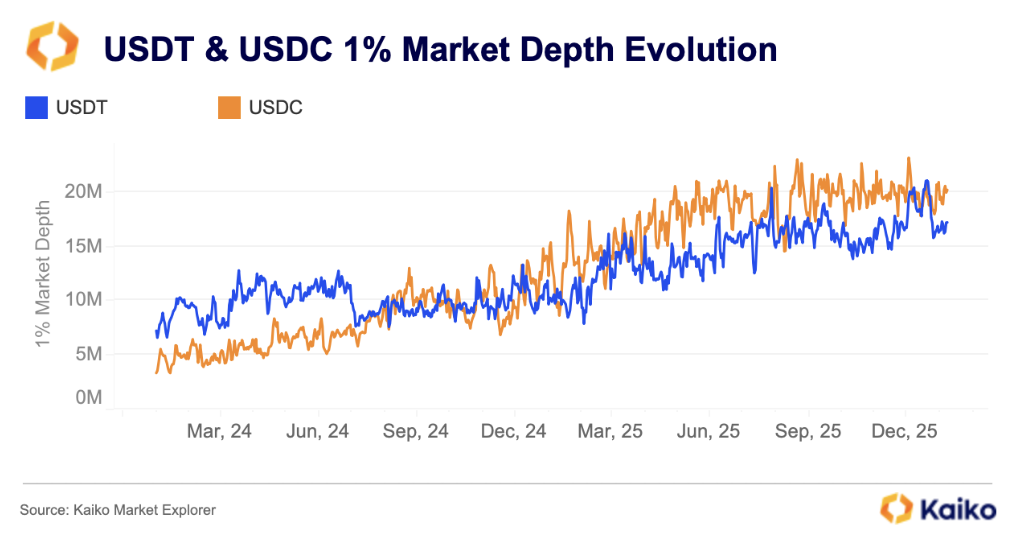
To take the example of stablecoins, these instruments have shown very solid metrics, particularly in terms of liquidity. The liquidity of Tether (USDT) and USD Coin (USDC) has increased considerably over the past two years, with market depths exceeding those of Bitcoin (BTC), which is viewed very favorably from an institutional point of view.
This WEF has indeed confirmed the institutionalization of crypto. Nevertheless, the forum was also marked by a confrontation between Brian Armstrong, CEO of Coinbase, and François Villeroy de Galhau, Governor of the Bank of France, firstly regarding stablecoins and interest rates, and secondly regarding BTC’s independence from central banks.
Two worlds clashed: Armstrong argued that American stablecoins should pay interest, while Villeroy maintained that this represented a systemic risk for traditional banks and invoked the need for stability in the financial system. Regarding the debate on independence, the Governor of the Bank of France emphasized the importance of institutional sovereignty and democracy as a guarantee of trust, while the Coinbase CEO countered that BTC’s independence was even greater because it is not tied to any country or individual. This debate allowed us to witness the stark differences in perspective that exist between traditional financial players and those in the crypto industry.
Want the full analysis?
Subscribe to Kaiko Research Premium for more market insights.

MORE FROM KAIKO
![]()
Perspectives
New York
Insights from the Q1 2026 Kaiko Exchange Ranking
Learn more about the critical role of regulated data in the effective deployment of safe and secure smart contracts.
17/03/2026
Read More![]()
Perspectives
New York
How Smart Contracts Break Without Regulated Data
Learn more about the critical role of regulated data in the effective deployment of safe and secure smart contracts.
12/03/2026
Read More![]()
Company
New York
Q1 2026 Kaiko Blockchain Ecosystem Ranking Released
The Q1 2026 Kaiko Blockchain Ecosystem Ranking has been launched, with Ethereum, Solana, and Arbitrum leading the way.
11/03/2026
Read More