S&P Global Leads Strategic Investment in Kaiko, Extending Series B to $110 Million



- Home
- Resources
- Perspectives
From Crisis to Confidence: Building Regulated Infrastructure for Tokenized Collateral
Building Institutional Infrastructure for Tokenized Money Market Funds
UK pension funds holding £36 billion in government bonds triggered a systemic crisis requiring the Bank of England to intervene, not from bad assets, but because data infrastructure couldn’t keep up with market volatility. Three unsolved data problems remain for tokenized MMFs at scale. Fragmentation across Ethereum, Stellar, Polygon, and Canton with inconsistent valuations, no continuous monitoring, and no standard data model or governance framework for automated workflows. Kaiko operates as a regulated Benchmark Administrator providing continuous indicative valuation with sub-minute latency across all platforms 24/7. Ownera‘s FinP2P Router enables institutions to integrate once and gain automatic connectivity to all participants with no bilateral integrations required.
- The 2022 UK gilt crisis revealed a critical gap
- Three unsolved problems for tokenized MMFs at scale
- Kaiko and Ownera’s infrastructure solution
Delivering data infrastructure through the SuperApps model
In February 2025, Global Digital Finance (GDF) launched an industry Working Group to set out how tokenized money market funds could be leveraged as collateral in derivatives margin trading in the EU and the UK. The initiative brought together over 70 firms, including State Street, UBS, Lloyds, and Commerzbank, to address legal, operational, and technical requirements for tokenized MMFs to function as collateral at institutional scale.
Within the Working Group, GDF launched the Industry Tokenized MMF Sandbox, powered by Ownera, to test workflows for eligibility determination, margining, substitution, and settlement across different collateral use cases. The Sandbox evaluated infrastructure requirements for real-time monitoring, cross-platform interoperability, and automated execution. The EU and UK Working Group concluded in October 2025, establishing standards for eligibility, operational mechanics, and risk management when these funds serve as margin in derivatives, repo, and securities lending, serving as an important systemic risk mitigation mechanism for global markets.
Building on these results, GDF and ISDA launched a separate industry Working Group in January 2026, bringing together institutions including J.P. Morgan, Goldman Sachs, and BNY, to focus on the U.S. market and opportunity.
GDF has again mobilized the TMMF Industry sandbox, also powered by Ownera, which aims to establish similar frameworks tailored to the U.S. market.
A reminder of the importance of this work is the 2022 UK gilt crisis, which shone light on what happens when infrastructure cannot keep pace with market turbulence and anchors the importance of the digitalization and future-proofing of capital markets.
The 2022 warning
In September 2022, UK pension funds holding £36 billion in government bonds, among the safest assets on Earth, triggered a systemic crisis requiring a Bank of England intervention. These were institutional pension funds managing retirement savings, forced to liquidate high-quality assets at fire sale prices because they could not move collateral fast enough.
UK pension funds used liability-driven investment (LDI) strategies with leverage through repo markets and interest rate swaps. When the government announced unfunded tax cuts on September 23, gilt yields spiked. Funds faced immediate margin calls. They held plenty of high-quality government bonds to cover them, but could not move fast enough.
Net asset values (NAVs) updated once daily. Settlement took a full business day, even for urgent trades. Decisions required human approval during business hours only. No automated systems existed to trigger early rebalancing or substitute collateral.
By the time funds could act, markets had already moved further. Selling pressure pushed prices down. Lower prices triggered more margin calls. More margin calls forced more selling.
Just three firms accounted for 70% of the £36 billion in forced selling over three weeks. Transaction costs more than doubled in days. The Bank of England had to step in as a buyer of last resort to prevent systemic collapse.
Automated systems under stress
Automated protocols with real-time data feeds offer a different model. During the same volatile 2022 period, decentralized lending protocols processed hundreds of millions in collateral liquidations without systemic failures. Recent market stress episodes have shown that when collateral positions are transparent, and risk rules are executed automatically (margining, liquidations, eligibility), systems can respond faster than manual workflows. The lesson for tokenized MMFs is the need for continuously available, auditable data that can drive institutional-grade automation. Automated workflows combined with timely data reduce operational bottlenecks that can compound during stress, outperforming manual processes that work fine in normal markets become dangerous constraints when speed matters.
The root cause of the LDI crisis was not bad risk management or poor asset selection. It was operational speed. The data infrastructure to detect problems and trigger automated responses could not keep up with market reality.
Data latency prevented early detection and automated responses. That latency caused manual processes that were unable to keep up with market movements. This procyclicality became a systemic risk requiring central bank intervention.
The legal framework exists
BNY Mellon and Goldman Sachs have launched tokenized MMFs. BlackRock’s BUIDL fund is live on Ethereum. Franklin Templeton’s BENJI operates on Stellar. The legal framework for tokenization in general is already established, with jurisdictions including Luxembourg, Ireland, and the UK providing certainty for tokenized fund structures.
The sandbox will show how legal frameworks can be adjusted for tokenized MMFs to be used as collateral, addressing perfection of security interests, bankruptcy remoteness, operational workflows, and the data infrastructure that collateral operations require – proving tokenized money market funds work operationally and legally.
MMFs invest in short-term, high-quality debt instruments such as U.S. Treasury bills, government agency securities, and commercial paper. They aim to maintain a stable $1.00 NAV while providing liquidity and modest yield. MMFs represent a $6 trillion market and are widely used as cash management vehicles and collateral in institutional transactions.
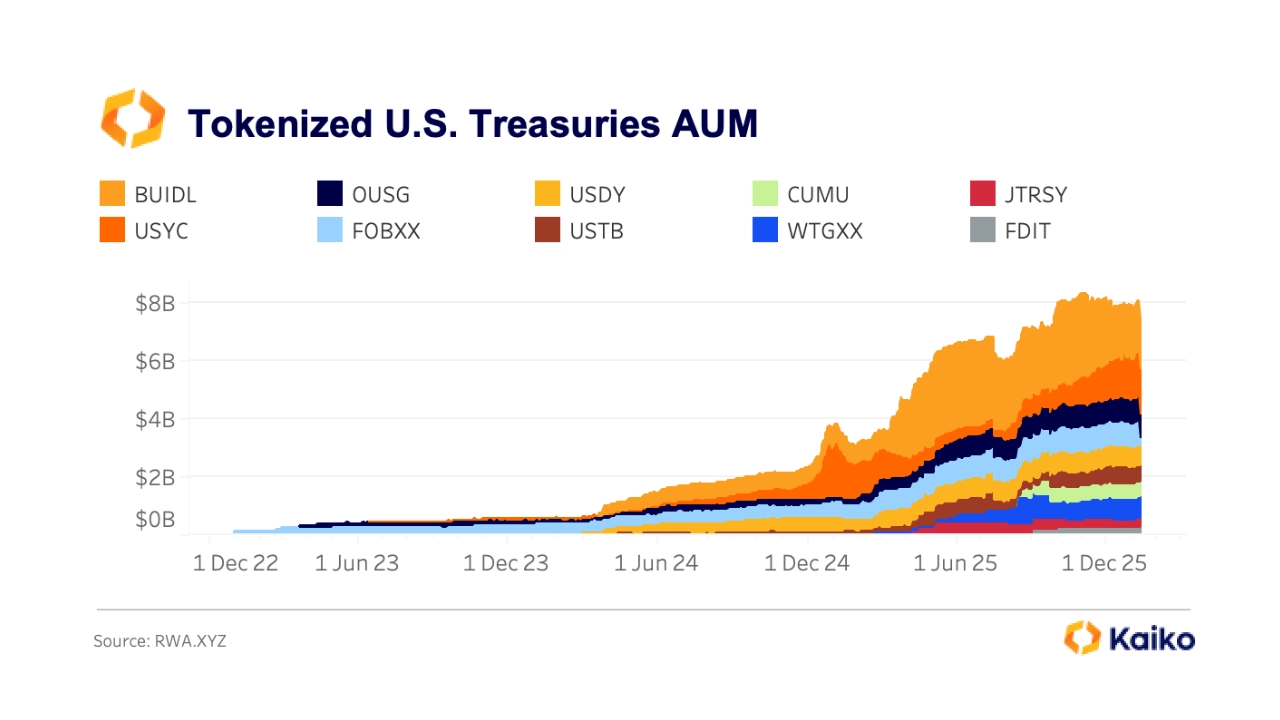
Tokenization has only achieved real scale in one category. Stablecoins dominate with $300 billion in market cap, representing 90 percent of all tokenized assets. They processed $33 trillion in transaction volume in 2025 alone. Meanwhile, U.S. tokenized treasuries sit at $8.4 billion. Private credit accounts for $6.0 billion. All tokenized assets excluding stablecoins sit at $29.4 billion combined.
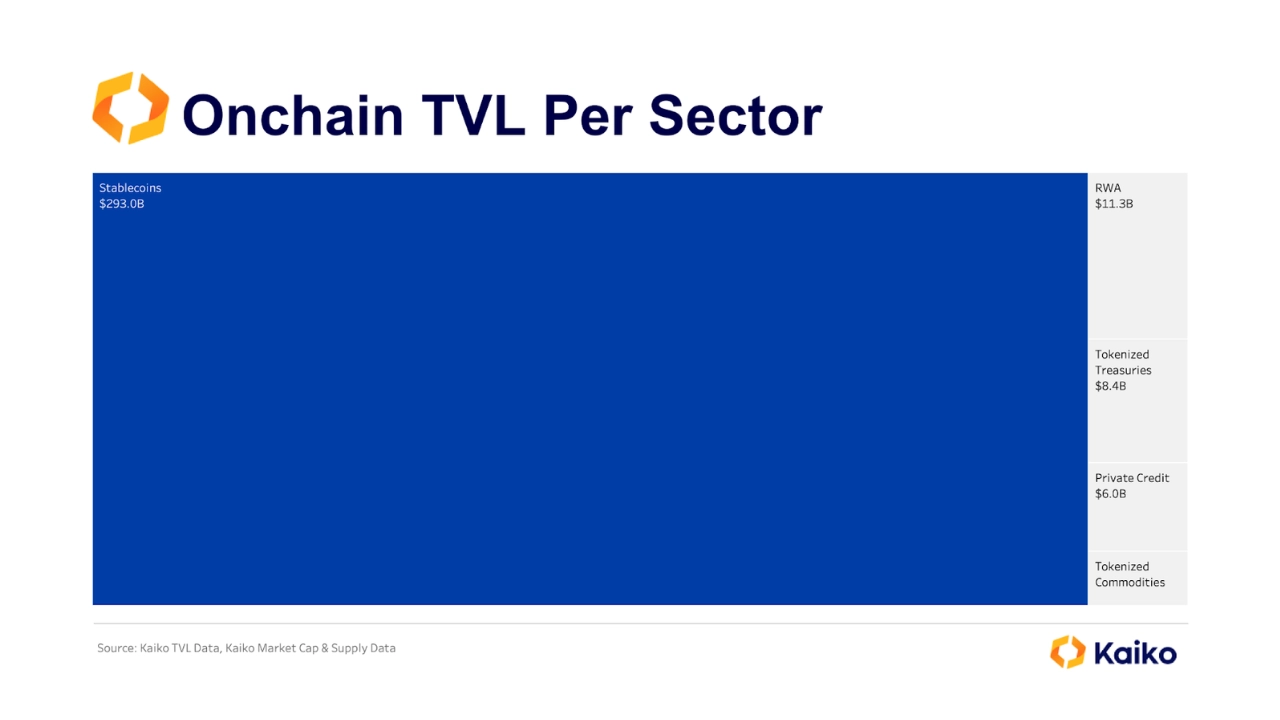
Stablecoins solved a simple problem. Monthly attestations from accounting firms prove each token is backed by equivalent off-chain assets. That simple data model enabled unprecedented scale.
Where TMMF collateral operations will strain first
Tokenized money market funds face exponentially more complexity. Daily NAV calculations incorporate treasury prices, accrued interest, fee structures, and redemption mechanics.
To function as institutional collateral, tokenized MMFs require continuous monitoring, automated reconciliation across platforms, and real-time depeg detection that triggers pre-programmed responses. This demands a minimum data set across five categories.
Price and valuation data must include official NAV plus continuous indicative monitoring values with timestamps and methodology tags. Reference data must provide universal identifiers, issuer and fund family mapping across chains, and eligibility flags. Risk attributes must cover weighted average maturity and life, liquidity buckets, and applicable ratings or constraints. The operational state must specify cutoffs, creation and redemption windows, and settlement assumptions. Rules data must document haircuts, concentration limits, thresholds, and versioning.
Without infrastructure operating at institutional scale with near real-time latency for monitoring and triggers, tokenized MMFs cannot support automated margining as scalable, low-dispute institutional collateral. The gap between tokenized settlement speed and traditional data publication speed becomes the bottleneck that prevents automated collateral operations. Supporting tokenized MMFs as collateral at scale will require extending traditional fund administration processes with higher-frequency data, standardized identifiers, and automated controls.
The three unsolved data problems
As tokenized MMFs move from pilots to institutional-scale collateral operations, three infrastructure gaps remain unresolved.
1. Fragmentation and Inconsistent Valuations Across Platforms
Funds launch on Ethereum, Stellar, Polygon, Canton, and Hedera. For example, a collateral manager viewing the same fund across platforms might see a 2 basis point difference. On $1 billion, that’s a $200,000 discrepancy.
When a price discrepancy between Ethereum and Stellar exceeds the tolerance band, a reconciliation process should trigger automatically, blocking further posting until resolved, with an audit trail capturing the event for dispute resolution.
2. No Continuous Monitoring or Automated Triggerability
Traditional administrators publish NAV once daily at 4 PM. If a fund depegs at 2 AM Saturday, manual systems discover it 14 hours later. Automated collateral substitution never triggers because no real-time monitoring exists. By the time intervention happens, the damage is done.
If the NAV drifts beyond a pre-agreed threshold from the official NAV, it should trigger an automated haircut adjustment, increase posting requirements by the amount, and initiate a substitution request if the threshold is breached.
3. No Standard Data Model or Governance Framework
Even with continuous data, institutions need accountability, methodology disclosure, and escalation rules that make automated actions trustworthy and legally enforceable. Without governance standards, automated workflows become operational risk.
If weekend monitoring detects a single issuer exceeds the allowable percentage of posted collateral, partial substitution should execute automatically.
Data Layer: Regulated Benchmarks and Continuous Monitoring
Solving these problems requires more than faster data feeds. It requires governance – accountability, methodology, controls, and escalation rules that make data and automated actions trustworthy, auditable, and enforceable across institutions.
Kaiko operates as a Benchmark Administrator under EU BMR and IOSCO principles, providing regulated oracle infrastructure for digital assets. This includes continuous indicative valuation and monitoring signals across all tokenized MMF platforms with sub-minute latency, distinct from official NAV publication by fund administrators. When a fund depegs at 2AM, alerts fire in near real-time, enabling automated responses. Cross-platform reconciliation provides unified indicative pricing across fragmented infrastructure, with methodology transparency and documented fallback procedures. Monitoring operates 24/7, including when underlying markets are closed, using the same regulated reference rate methodologies Kaiko applies as a Benchmark Administrator across digital asset markets like Kinetiq.
This creates the data foundation for automated depeg responses, intraday margin adjustments, and real-time collateral monitoring.
Workflow Layer: Institutional-Operated Execution at Scale
Data alone is insufficient. Institutions need workflow orchestration to act on that data across fragmented systems while maintaining control, clear liability, and operational oversight.
Ownera provides the institutional network infrastructure that solves this integration problem through the FinP2P Router. Institutions integrate once and gain automatic connectivity to every other participant in the network. There is no intermediary executing on behalf of institutions; instead, the Router enables direct peer-to-peer settlement coordination with execution, control, and liability remaining within institutional boundaries.
The tokenized MMF sandbox demonstrates this in practice. Ownera’s production deployment connected 50+ institutions in three months. Each institution integrated once to the Router, providing automatic connectivity to all other participants for collateral posting, margining, and substitution workflows. The network economics compound: as new participants join, every existing participant gains that connectivity automatically, without additional integration work.
For tokenized MMF collateral operations, this means institutions can orchestrate settlement across multiple blockchains (whether MMF tokens live on Ethereum, Stellar, or Canton), without platform lock-in. The Router consumes cross-chain services via open adapters including LayerZero, Chainlink CCIP, and issuer-native bridging protocols, allowing institutions to retain blockchain selection while coordinating workflows across the ecosystem.
Production-ready SuperApps built on the Router handle specific operational workflows. When Kaiko’s monitoring detects a depeg event at 2 AM Saturday, the Collateral Management SuperApp can execute pre-programmed responses: adjust haircuts automatically, trigger substitution requests to counterparties, and generate compliance documentation – all with governance controls, audit trails, and the ability to intervene when circumstances require human judgment.
The SuperApp model allows applications to stack and work together. The same Router integration that handles collateral management also supports intraday repo, securities lending, and payment obligations, with each application reinforcing the others through shared counterparty connectivity and asset definitions.
Data and Workflow at Scale
The combination of Kaiko’s regulated data infrastructure and Ownera’s institutional workflow network creates the foundation for tokenized MMFs to function as reliable, scalable collateral.
Kaiko provides the continuous monitoring, cross-platform reconciliation, and methodology-transparent valuations that make automated collateral decisions trustworthy and auditable. Ownera provides multi-party settlement coordination, counterparty connectivity, and production applications that turn those data signals into executable workflows without bilateral integration complexity or external intermediation.
Together, this addresses the operational infrastructure gap that prevented earlier tokenization efforts from scaling beyond pilots. Institutions no longer face a choice between committing to a single ecosystem or pursuing thousands of bilateral integrations. They integrate once to the Router, consume data from regulated sources, and deploy production-ready applications that work across the entire network.
The tokenized MMF sandbox demonstrates this in practice: 50+ institutions, multiple blockchains, zero bilateral integrations, production-ready in three months. Not a proof of concept. Not a controlled pilot with simplified workflows. Production infrastructure designed to handle the operational complexity and regulatory requirements that institutional collateral demands.
What This Means for Institutional Tokenization
The UK gilt crisis revealed that operational speed, not asset quality or risk management, can become systemic risk when data infrastructure and workflow execution cannot keep pace with market reality. Tokenized MMFs promise near-instant settlement and continuous capital optimization, but only if the surrounding infrastructure operates at the same speed and scale.
That infrastructure requires two layers working in concert. The first is regulated data that institutions can trust for automated decisions. The second is application-layer orchestration that maintains institutional control while eliminating bilateral integration complexity.
The defining questions are now architectural. How can we orchestrate workflows across fragmented platforms while maintaining oversight and enabling automation? How can we scale partner connectivity without exponential integration costs? And how can we ensure clear accountability and liability when systems execute in milliseconds?
For tokenized MMFs to function as institutional collateral, not in sandboxes but in production, under stress, at scale, these questions have answers. The data layer exists. The workflow layer exists. The legal frameworks are established. What remains is deployment, connecting the institutions, applications, and infrastructure that turn tokenization from promise into operational reality.
The 2022 crisis showed what happens when infrastructure cannot keep up. The 2025 sandbox shows what happens when it can.
Learn More
Kaiko is also hosting a webinar with Ownera “Making Tokenized MMF Collateral Operationally Reality,” featuring speakers from State Street, Franklin Templeton, and GDF.
Alternatively, you can learn more about Kaiko Data Services or contact us.
About Kaiko
Kaiko provides regulated data services for onchain finance. Founded in 2014, the company delivers institutional-grade digital asset market data, analytics, indices, and data infrastructure for tokenized and traditional markets. Its clients include banks, asset managers, exchanges, and leading financial institutions worldwide. Kaiko’s data and infrastructure support trading, valuation, risk management, tokenized assets, and onchain applications, connecting traditional and blockchain-based markets.
About Ownera
Ownera is a UK fintech and global leader in digital asset interoperability, connecting financial market infrastructure to enable major financial institutions to seamlessly trade, settle and manage tokenized assets across any blockchain, legacy ledger or network with institutional-grade security and compliance. The company’s use of open-source FinP2P technology combines routers that provide seamless interoperability and atomic settlement across multiple chains and asset classes, orchestrating over $5 billion in monthly trading volume between counterparties and their regulated service providers (including custodians, broker-dealers, transfer agents, cash providers and lenders). Ownera’s SuperApps Platform unlocks advanced use cases through best-in-class applications including intraday repo, collateral mobility, public and private markets distribution and trading, and real estate fund mobility – driving unprecedented liquidity and market efficiency in institutional digital finance. For more information, visit www.ownera.io
More From Kaiko
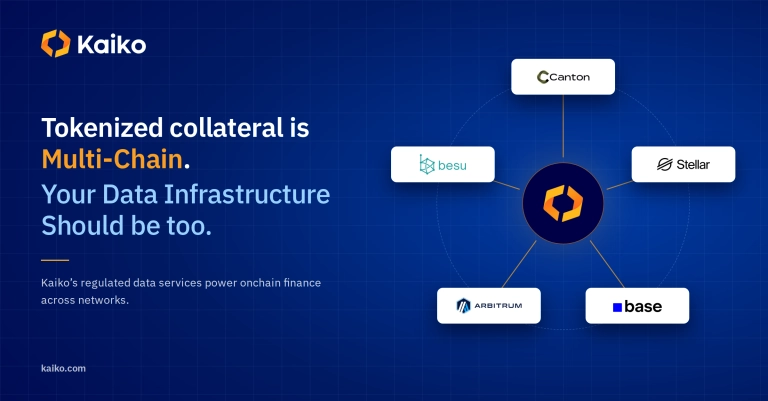
![]() Tokenized Collateral Is Multi-Chain, So Your Data Infrastructure Should Be Too.
Tokenized Collateral Is Multi-Chain, So Your Data Infrastructure Should Be Too.19/08/2026
PerspectivesAs tokenized real-world assets become collateral across public and private blockchains, institutions need reliable data wherever those assets sit. This article explores the multi-chain infrastructure powering tokenized markets and how Kaiko delivers regulated, trusted reference data across networks, helping create a consistent source of truth for pricing, settlement, and collateral management.
![]() Deep Dive: Tokenization
Deep Dive: Tokenization17/07/2026
PerspectivesLearn more about tokenization infrastructure, how real-world assets are brought on-chain, and the data standards required for successful institutional adoption.
![]() A New Economic Model for Oracle Services on Canton
A New Economic Model for Oracle Services on Canton23/06/2026
PerspectivesWe explore the new economic model for oracle services on Canton, where CIP-0104 ties app rewards to real network traffic rather than activity markers, improving cost efficiency at scale.
![]() The Future of Onchain Finance with Lance Uggla
The Future of Onchain Finance with Lance Uggla18/06/2026
PerspectivesDrawing on the rise of OTC derivatives, we explore why trusted, independent pricing data is the missing market infrastructure piece for tokenized assets and onchain capital markets.
![]() How S&P DJI and Kaiko are bringing IP-protected market data onchain
How S&P DJI and Kaiko are bringing IP-protected market data onchain16/06/2026
PerspectivesWe discuss how S&P DJI and Kaiko are bringing IP-protected market data onchain, treating data as a financial asset with controls and monetization built in.
![]() Institutional finance on the blockchain: A future in progress
Institutional finance on the blockchain: A future in progress09/06/2026
PerspectivesWe explore how trusted data partnerships are bridging onchain and offchain markets for institutional use.