S&P Global Leads Strategic Investment in Kaiko, Extending Series B to $110 Million



Inside Out Canton, Ecosystem & Coin
07/05/2026
This is a special edition of the Index in Focus following the recently announced launch of the 21shares Canton Network ETF (Ticker: TCAN) powered by Kaiko Indices.
Author: Thomas Probst, Research Analyst
Introduction
21shares, one of the world’s leading issuers of crypto exchange-traded funds (ETFs), announced the launch of the 21shares Canton Network ETF (Ticker: TCAN). The fund is the first U.S. ETF designed to offer investors direct exposure to the Canton Coin (CC), the native utility token of the Canton Network.
In this context, this report provides an overview of the Canton ecosystem, the role of its validator network, and what exposure to Canton may represent for investors. It also analyzes Canton Coin’s market behavior, including its performance, correlation profile, volatility, liquidity, and trading volumes, to better understand how the asset has evolved since launch and how it compares with the broader crypto market.
1. UNDERSTANDING CANTON AND ITS ECOSYSTEM
Canton is a blockchain infrastructure that, unlike most public blockchains, which prioritize openness and universal transparency, was developed to enable financial institutions, asset managers, market infrastructures, and regulated companies to exchange assets and data on a shared network, while maintaining a high level of confidentiality, compliance, and operational control.
Canton’s originality lies in its interoperable network architecture where different applications and participants can interact on the same infrastructure layer without exposing all data to all network members. This approach addresses a key constraint, particularly in institutional markets, where transactions often need to be shared only among the relevant parties, while remaining verifiable and coordinated across a broader ecosystem. Canton aims to reconcile the benefits of distributed ledger technology, such as automation, synchronization, and reduced post-trade friction, with the confidentiality and governance requirements expected in regulated finance.
What an Investment in Canton Represents
For an investor, Canton offers more than just broad exposure to blockchain technology. It can be understood as exposure to a digital infrastructure designed to support the development of a new generation of tokenized and interconnected financial markets. Canton now has more than 1000 validators, over 28,000 wallets, and processes more than 600,000 transactions per day, pointing to a network that has moved beyond experimentation into active usage. Canton has $9 trillion in monthly transaction volumes, while key use cases include tokenized real-world assets, U.S. Treasury repo, private stablecoin payments, collateral mobility, and 24/7 financing workflows.
An investment in Canton can therefore be analyzed as exposure to several underlying dynamics. The first is the growth of economic activity within the ecosystem, meaning the increase in the number of applications, participants, transactions, and assets traded on the infrastructure. The second is the value of institutional interoperability, in a context where financial markets are seeking solutions to connect previously fragmented platforms. The third is the credibility of the network’s technological and governance model, which must be robust enough to meet high expectations for security, resilience, privacy, and regulatory compliance.
“The industry has done the foundational groundwork over the last decade to demonstrate that blockchain technology can transform traditional markets constrained by legacy market cutoffs, settlement windows, and fragmented infrastructure, but privacy has been the primary barrier to large-scale institutional adoption. Canton uniquely matches the speed and efficiency of blockchain rails with the privacy, control and compliance required by regulated markets.” said Yuval Rooz, CEO of Digital Asset and co-founder of the Canton Network.
The Canton Validators Network: Principles and Operation
The Canton Validators Network refers to all the validators involved in maintaining, coordinating, and securing the network. In a blockchain architecture, validators are the entities responsible for verifying, ordering, or confirming certain transactions according to the protocol rules. Their role is essential, as they allow the network to function consistently without relying on a single central authority.
In the Canton environment, the validator network is designed to support a distributed trust model adapted to institutional uses. This means that validation is not based solely on the logic of a completely permissionless public network, but is embedded in an architecture where operator reliability, governance, technical standards, and compliance requirements play a significant role.
More specifically, validators serve as participant nodes that access the network and validate the transactions relevant to them, while Super Validators operate the Global Synchronizer itself, providing the shared ordering, coordination, and governance layer. The Global Synchronizer is currently operated by 13 active Super Validators.
The proper functioning of the Canton Validators Network is therefore central to the ecosystem’s value proposition. The more robust, diverse, and institutionally reliable this validator network is, the more it strengthens trust in the underlying infrastructure. In this context, reliability refers to the presence of validators that are operationally resilient, technically capable, and subject to governance, risk, and compliance standards consistent with institutional-grade infrastructure.
2. IN-DEPTH ANALYSIS OF THE CANTON COIN
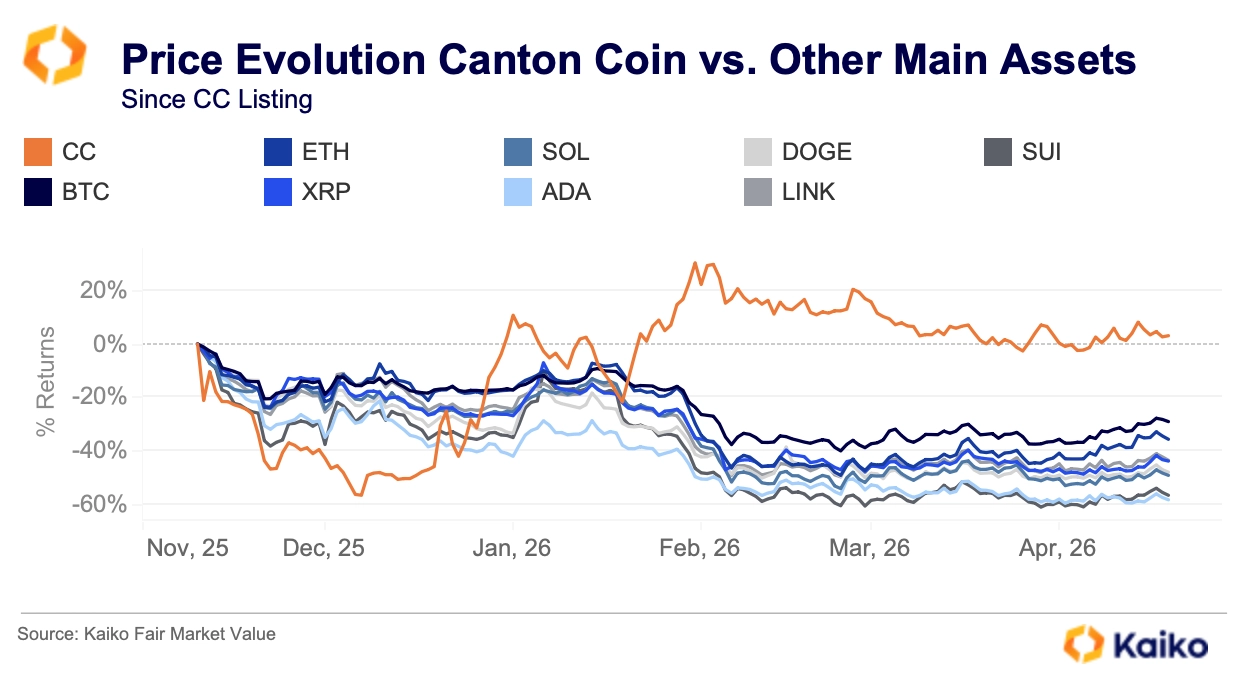
Over the observed period, Canton Coin diverged from the broadly bearish crypto market. The trend across major digital assets had already turned negative in January and worsened further after Kevin Warsh’s nomination on January 30 as the next Federal Reserve chair, which reinforced expectations of a less supportive macroeconomic and monetary backdrop for risk assets. In that context, the broader crypto market entered a phase of generalized decline followed only later by limited stabilization. By contrast, CC recovered more strongly and maintained a meaningfully more resilient trajectory, making it a clear outlier in an otherwise stressed environment.
This suggests that Canton Coin has been supported by asset-specific drivers tied to its ecosystem and differentiated positioning. Since its listing, CC has broadly outperformed the main large-cap crypto assets. While BTC is down roughly 30%, ETH about 35%, and XRP around 40%, Canton Coin has recovered from an early drawdown to peak at around +30% in late February. This relative resilience points to market dynamics that have been materially less correlated with the broader large-cap crypto complex.
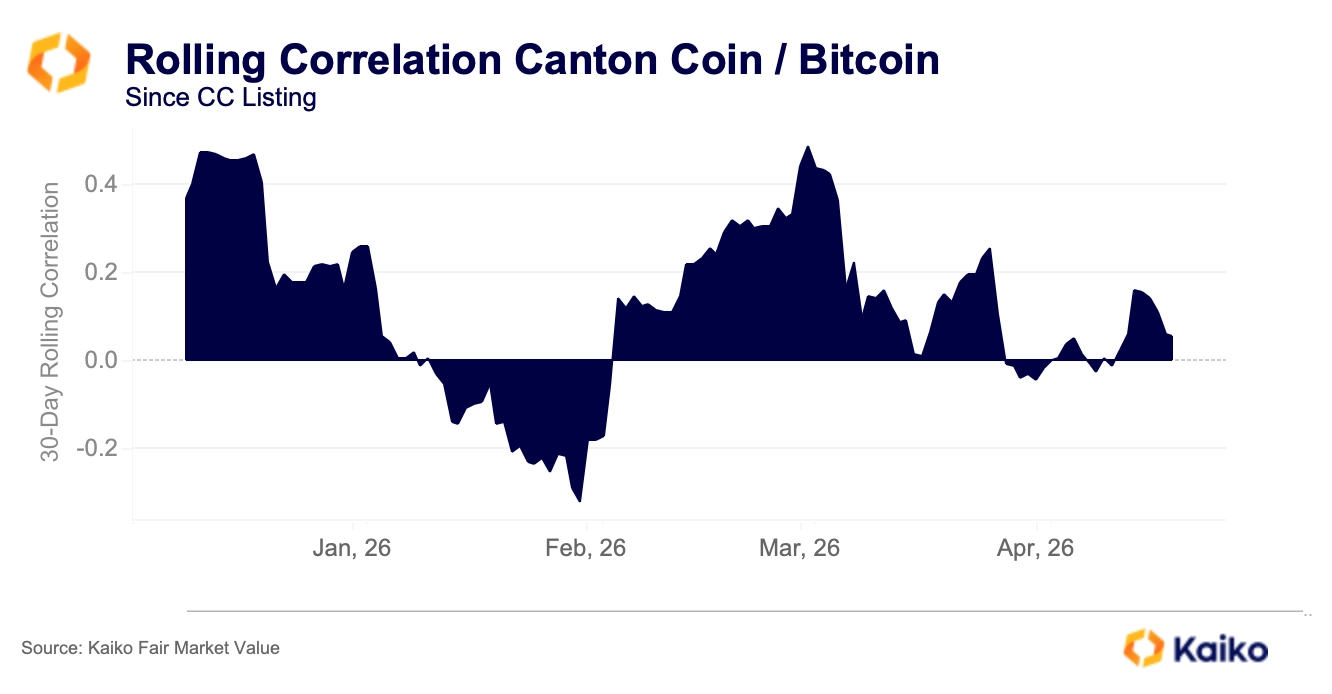
The correlation between BTC and CC appears unstable, sometimes moderately positive, sometimes close to zero, or even strictly negative. Canton Coin’s movements have not consistently aligned with those of Bitcoin, which nevertheless remains the market’s leading asset. This dynamic suggests that Canton Coin exhibits a distinct behavioral profile from BTC, suggesting that its performance may have been influenced more by factors specific to its own ecosystem than by the overall market direction.
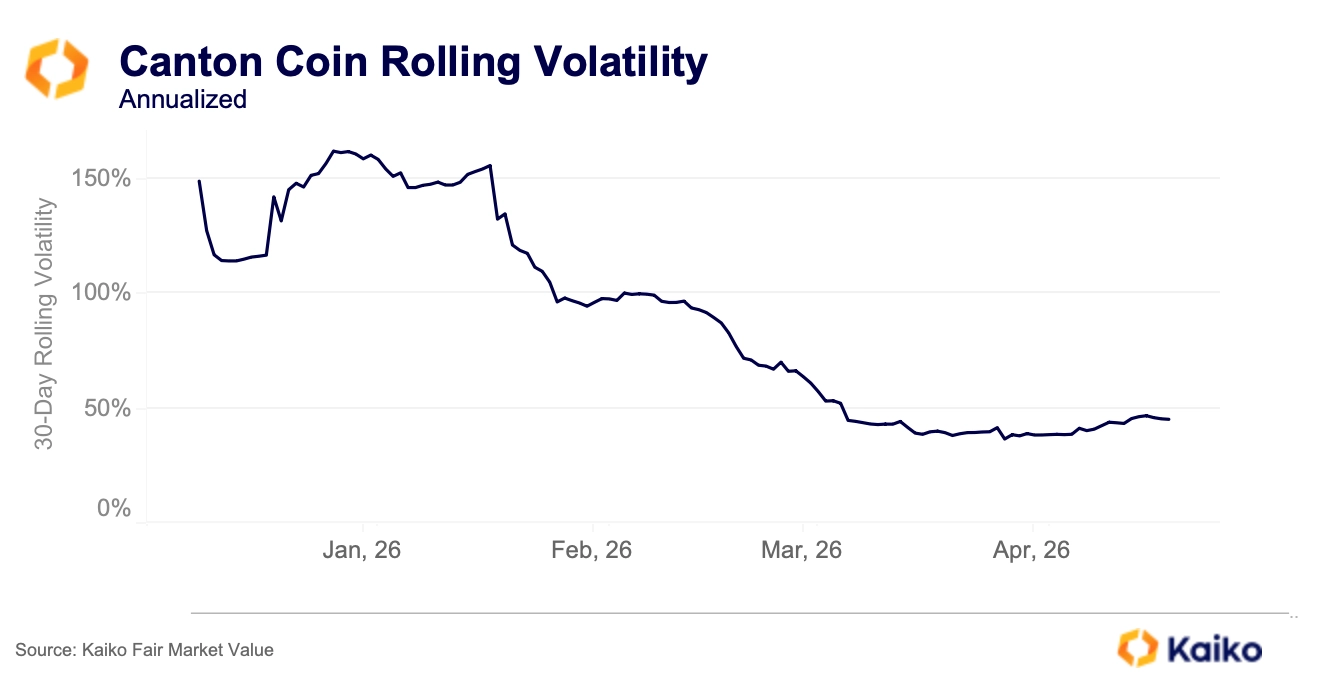
Building on these observations, the volatility dynamics of Canton Coin provide further insight into the asset’s risk profile. Over the entire period, volatility has followed a distinctly downward trend, suggesting a gradual normalization phase. This decline can be interpreted as a sign of relative maturation of Canton Coin, which is still a very young asset. However, this should not obscure the still high level of volatility. With the latest observation around 45%, Canton Coin maintains a significant risk profile.
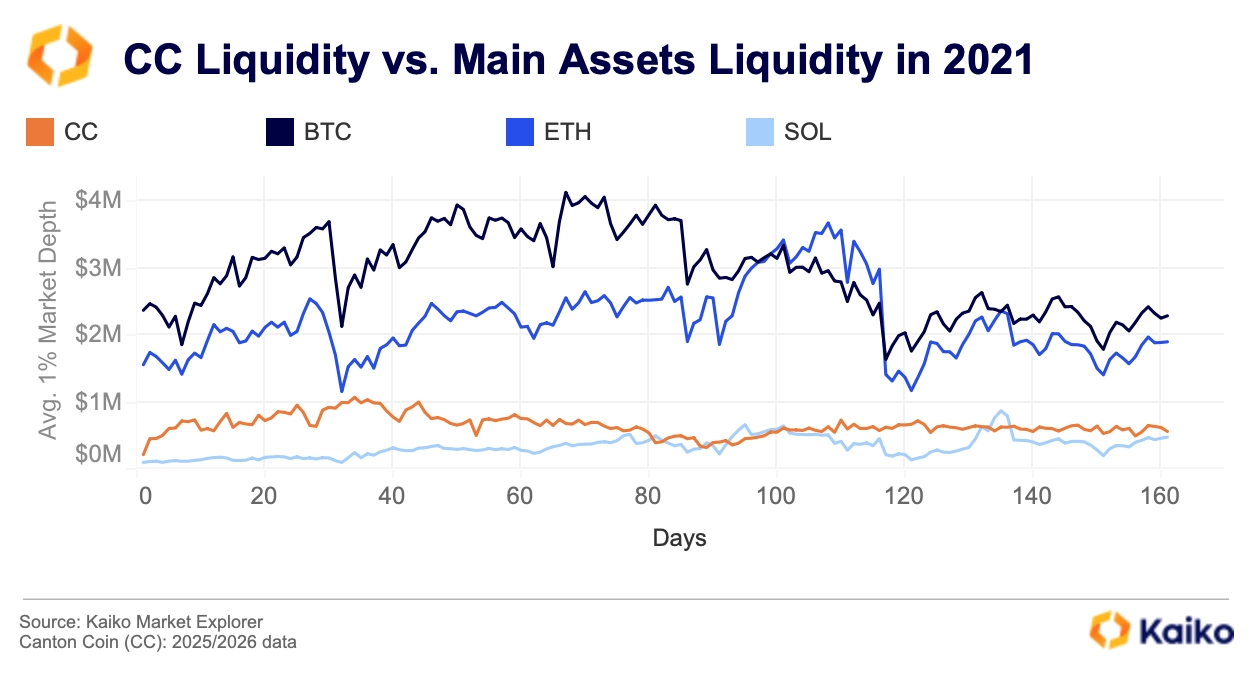
Market depth measures the cumulative buy and sell volume available around the current market price and is therefore a key indicator of an asset’s ability to absorb transactions without causing excessive price fluctuations. In the case of Canton Coin, this depth remains materially lower than that of the major market capitalizations, and thus can be considered less liquid.
Despite having lower liquidity than the main assets, Canton Coin meets the criteria of Kaiko’s index methodology, which imposes minimum liquidity to ensure sufficiently robust inclusion and preserve the stability of the index.
“When Canton Coin first listed on centralized exchanges, we adapted our methodology to extract the most information from the market while filtering out noise, and maintaining a high level of reliability, robustness, and manipulation resistance. In those early weeks, liquidity is scattered, price discovery is volatile, and the market needs a reference point it can trust from day one. Now that Canton Coin has several months of trading history, our standard methodology takes over seamlessly. Through optimized exchange selection based on governance, quality, and liquidity criteria, we ensure the benchmark reflects the true state of the market, giving investors an accurate price at every stage of the asset’s lifecycle.” said Anne-Claire Maurice, Managing Director for Derived Data at Kaiko.
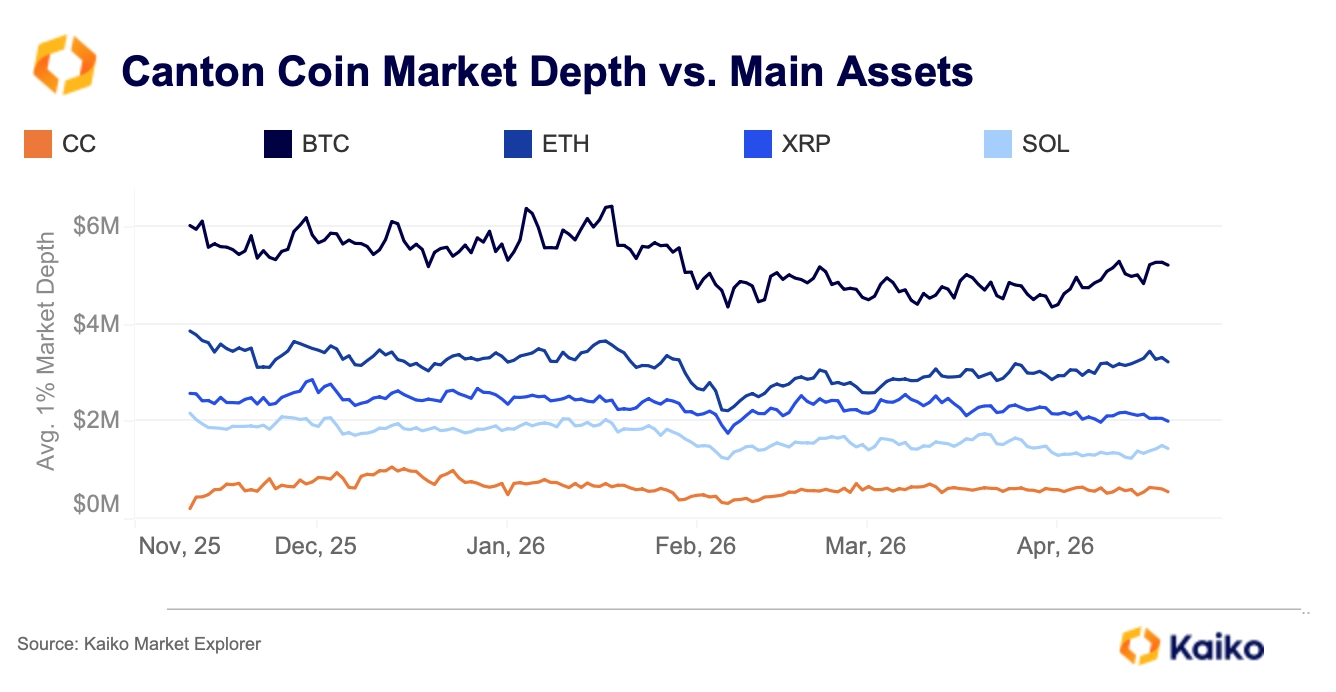
However, this lower liquidity needs to be put into context. Canton Coin is a relatively new asset, and its current liquidity is closer to that seen on some major assets a few years ago. For example, in 2021, the liquidity gap was less pronounced, and Canton Coin’s liquidity was similar to that of SOL.
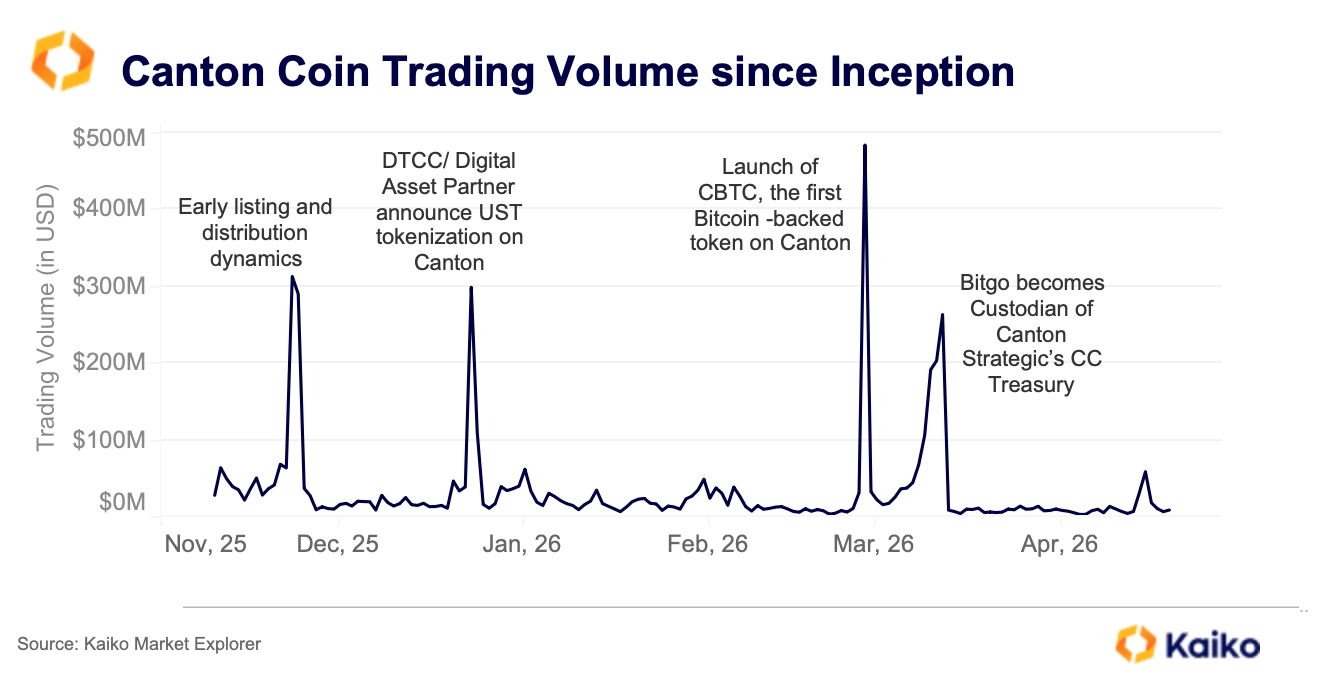
The trading volume profile supports this pattern. Since its launch, Canton Coin’s trading volume has exhibited a highly event-driven dynamic, alternating between periods of moderate activity and sudden volume spikes, followed by rapid normalization. These movements suggest liquidity that is particularly responsive to announcements and market catalysts.
For example, the launch of CBTC, the first Bitcoin-backed token on Canton, at the end of February sharply boosted activity, generating the largest volume spike observed since the token’s listing on secondary spot markets. Early March, its volume also gradually increased, driven in particular by the arrival of new institutional Super Validators.
CONCLUSION
The launch of the 21shares Canton Network ETF (ticker: TCAN), the first U.S. ETF offering direct exposure to Canton Coin, adds to a growing set of regulated, exchange-listed instruments tied to the Canton ecosystem. This follows the February Nasdaq listing of Canton Strategic Holdings (ticker: CNTN), meaning investors now have multiple ways to access Canton Coin within familiar market structures. As the network continues to scale, Canton Coin’s gradually normalizing volatility, event-driven trading activity, and low correlation to major crypto assets position it as a distinctive, if still early-stage, exposure in the digital asset landscape.
More Data blogs from Kaiko
![]() REPORT: The Verticalization Thesis: How Blockchain Revenue Models Are Evolving
REPORT: The Verticalization Thesis: How Blockchain Revenue Models Are Evolving16/07/2026
Data BlogThis report provides an overview of the evolving business model of blockchain networks. We analyze incumbents and newcomers, showing how each of them leverages verticalization differently to answer a simple question: How is the business model of blockchain networks evolving?
![]() REPORT: Crypto Exchanges are Building Financial Super Apps for the Next Billion Users
REPORT: Crypto Exchanges are Building Financial Super Apps for the Next Billion Users15/07/2026
Data BlogThis report examines how leading crypto exchanges are evolving from trading venues into integrated financial platforms spanning trading, yield, payments, custody, and collateral. Using a four-layer framework, it explores how liquidity, retained balances, onchain payments, and institutional collateral rails are reshaping exchange competition.
![]() REPORT: Measuring Risk in Crypto Options
REPORT: Measuring Risk in Crypto Options11/06/2026
Data BlogIn this report, Kaiko and MerQube analyze how crypto-native and ETF Bitcoin options priced risk differently across two parallel markets in 2025.