S&P Global Leads Strategic Investment in Kaiko, Extending Series B to $110 Million



Why Pricing Matters.
Financial markets are only as trustworthy as the prices they operate on. However, the expansion of digital asset ETFs and the tokenization of real-world assets have made obtaining accurate prices more difficult. With many assets now trading both on and offchain, the same asset is often traded across multiple venues, each at a different price. So, how do you determine the “right price” to be used as a benchmark?
Traditionally, the “right price” is referred to as the “principal market” – i.e., the venue with the greatest volume and level of activity. But now, with several venues — both on and offchain — trading the same asset, each with similar trading volumes and liquidity, which venue should be used as the principal market?
We discussed this at length at The Agora, where institutional leaders gathered to talk through the real challenges of digital asset adoption. Two industry experts share their perspective.
“In this world, where we are slowly inching towards having securities that can be tokenized but also have an offline version of it, the calibration of what has been traded becomes really important. And it’s important to have that integrity between these offchain and onchain systems. And also, the number of chains has multiplied in the last few years. It’s probably a good thing to have that kind of diversity among chains, but equally, it makes it a harder task to bring all of that data together, which actually can be input into accurate pricing.”
– Nithya Sridharan, Product Director, TP ICAP
“Instead of relying on fragmented markets for the price, we would actually rely with the ETF on regulated index providers, which marks actually a really big step forward into institutional adoption. So all in all, from a system point of view, if you want to go into trading of ETFs, you need to adapt your infrastructure to something that looks much more similar to the one that exists today for equities, commodities, or traditional assets.“
– Solene Khy, Head of Product Management, Commodity, Equity, FX and Digital Assets, Murex
In the new world of multi-venue trading, the only way to get a reliable benchmark price is to have a trusted third-party provider as the voice of authority. That third party should regularly assess all trading venues to determine the most suitable for a benchmark, and aggregate the live trading prices from the selected venues to arrive at a consensus price.
Kaiko’s trusted expertise and data fill this gap
As a registered benchmark administrator, Kaiko provides enterprise-grade Reference Rates covering a wide range of asset classes that combine data from multiple vetted sources into a single robust rate. Kaiko uses a rigorous vetting process to ensure only credible exchanges are used in the rates. They offer a single robust rate determined by high standards of governance and compliance that institutions can rely on.
But this only solves pricing. The other part is the data infrastructure that makes accurate benchmarks available where they’re needed (onchain or offchain), while reading trades from both onchain and offchain venues to ensure that all relevant venues are included in the benchmark calculation. This is the core offering of Kaiko’s Data Infrastructure.
Together, Kaiko’s Reference Rates and data infrastructure can eliminate any pricing disparity between onchain and offchain markets, helping institutions operate in different environments seamlessly.
Learn more about Kaiko’s Data On-Ramp and Benchmark Reference Rates.
More From Kaiko
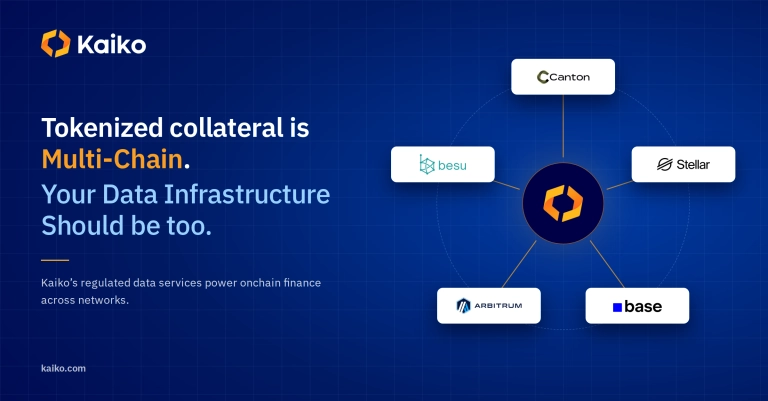
![]() Tokenized Collateral Is Multi-Chain, So Your Data Infrastructure Should Be Too.
Tokenized Collateral Is Multi-Chain, So Your Data Infrastructure Should Be Too.19/08/2026
PerspectivesAs tokenized real-world assets become collateral across public and private blockchains, institutions need reliable data wherever those assets sit. This article explores the multi-chain infrastructure powering tokenized markets and how Kaiko delivers regulated, trusted reference data across networks, helping create a consistent source of truth for pricing, settlement, and collateral management.
![]() Deep Dive: Tokenization
Deep Dive: Tokenization17/07/2026
PerspectivesLearn more about tokenization infrastructure, how real-world assets are brought on-chain, and the data standards required for successful institutional adoption.
![]() A New Economic Model for Oracle Services on Canton
A New Economic Model for Oracle Services on Canton23/06/2026
PerspectivesWe explore the new economic model for oracle services on Canton, where CIP-0104 ties app rewards to real network traffic rather than activity markers, improving cost efficiency at scale.
![]() The Future of Onchain Finance with Lance Uggla
The Future of Onchain Finance with Lance Uggla18/06/2026
PerspectivesDrawing on the rise of OTC derivatives, we explore why trusted, independent pricing data is the missing market infrastructure piece for tokenized assets and onchain capital markets.
![]() How S&P DJI and Kaiko are bringing IP-protected market data onchain
How S&P DJI and Kaiko are bringing IP-protected market data onchain16/06/2026
PerspectivesWe discuss how S&P DJI and Kaiko are bringing IP-protected market data onchain, treating data as a financial asset with controls and monetization built in.
![]() Institutional finance on the blockchain: A future in progress
Institutional finance on the blockchain: A future in progress09/06/2026
PerspectivesWe explore how trusted data partnerships are bridging onchain and offchain markets for institutional use.