S&P Global Leads Strategic Investment in Kaiko, Extending Series B to $110 Million



- Home
- Resources
- Perspectives
Deep Dive: Tokenization
Deep Dive: Tokenization Infrastructure
What is a tokenization, and how does it work?
Tokenization (of financial instruments or vehicles) is the process of creating a digital representation of a real or financial asset on a blockchain. In practice, this means that ownership rights, cash flow claims, and other economic interests linked to an offchain asset are incorporated within on-chain tokens that can be issued, transferred, and, in some cases, settled programmatically using smart contracts.
The key distinction compared to just issuing a crypto asset is that tokenization ties a digital token to the contractual and economic characteristics of an existing asset, while crypto assets are blockchain-native. The token becomes the mechanism through which ownership is recorded, transferred, and settled, while the underlying asset continues to exist in the real world, governed by applicable law and held by a custodian or trustee.
What tokenization enables that traditional infrastructure cannot
Traditional capital markets infrastructure was built for a five-day settlement cycle, defined business hours, and bilateral relationships managed through intermediaries. It works, but it creates friction at every stage:
- Settlement risk accumulates during the delay between trade execution and final delivery
- Reconciliation errors require manual resolution
- Access to assets is often gated by geography, minimum investment thresholds, or legacy connectivity requirements.
Tokenization infrastructure changes the underlying architecture. When an asset is represented onchain, settlement becomes atomic. As a result, delivery and payment occur simultaneously, within the same transaction, hardcoded at the protocol level. This eliminates the need for manual reconciliation, removing the threat of counterparty risk accumulating overnight, and closes any settlement gap entirely. Because atomic settlement is enforced by smart contract logic rather than intermediary workflows, there is no window for failure between leg one and leg two of a trade.
Beyond improved settlement, tokenized assets can clear and settle 24/7, unconstrained by the operating hours of legacy clearinghouses. And because they conform to composable token standards, they can interact natively with other onchain assets and protocols through a single shared execution environment, rather than rebuilding point-to-point connectivity for each new counterparty relationship. These structural advantages are why every major financial institution, from BlackRock and Broadridge to Franklin Templeton, has launched or is actively building tokenized asset products.
What is RWA tokenization?
Real-world asset (RWA) tokenization refers specifically to applying the tokenization process to assets that originate and derive their value offchain, for example, government & corporate bonds, money market funds, private credit, equities, real estate, commodities, and other financial instruments.
The tokenization of real-world assets is distinct from native crypto assets in that a native crypto asset carries no underlying real-world legal or physical claim, whereas a RWA token does, whereas an RWA token does. Its value, legal enforceability, and compliance requirements all depend on real-world circumstances, as it’s governed by real legal frameworks and administered by real entities. This means the data flowing between the offchain world and the onchain token is the foundation on which every downstream automated action rests.
RWA tokenization can be applied to a broad range of asset classes, but the current focus of institutional adoption is concentrated on areas where the operational efficiency gains are the clearest:
- Tokenized government bonds and money market funds – 24/7 availability and programmable collateral mobility add genuine value.
- Tokenized private credit and funds – Fractionalization and secondary market access address historically illiquid structures.
- Tokenized equities and fixed income instruments – Atomic or same-day settlement significantly reduces counterparty exposure compared to traditional markets, where fixed income and cross-border transactions can still carry T+2 or longer settlement cycles.
Why financial institutions are embracing digital asset tokenization
The institutions driving tokenization adoption are leveraging blockchain technology to solve real operational problems that have existed in capital markets for decades. This efficiency argument is already supported by results:
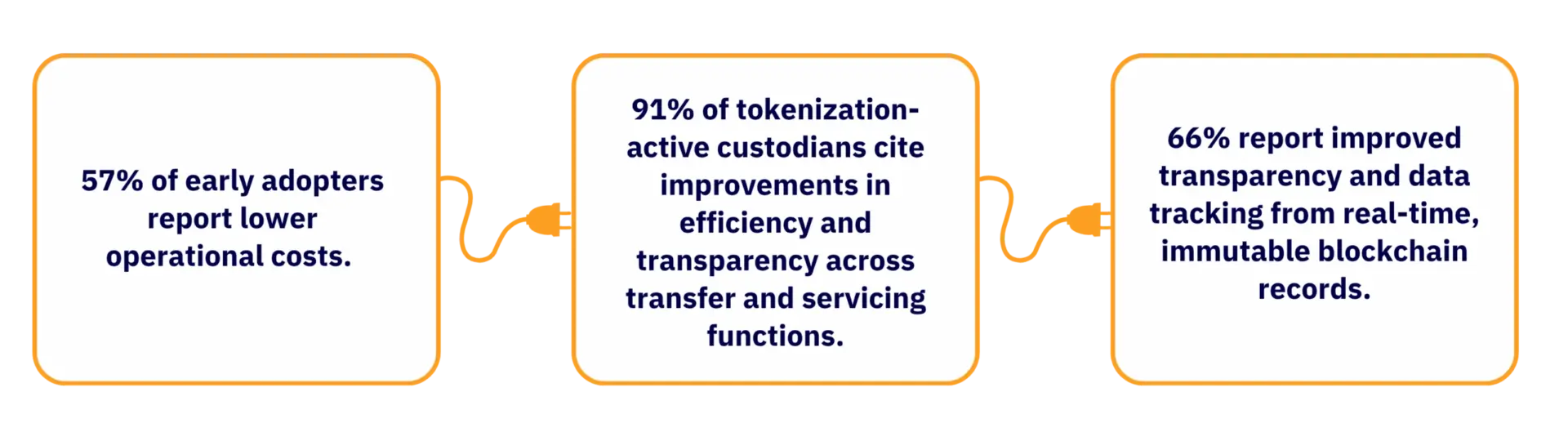
Source: Broadridge Tokenization Survey
Beyond cost reduction, the structural benefits of digital asset tokenization present significant opportunities as well:
Programmability
Smart contracts automate workflows that previously required manual intervention, from interest distributions and margin calls, to collateral substitution and Net Asset Value (NAV) calculation.
Automatic Settlement
Transfer of ownership and payment occur simultaneously, significantly reducing the settlement gap and the counterparty risk that comes with it.
24/7 Availability
Tokenized assets can trade and settle continuously, rather than being constrained by traditional market hours and cut-off times.
Collateral Mobility
Tokenized assets can move between counterparties within compatible networks in real-time, removing the operational bottleneck that arises when institutions hold sufficient collateral but cannot mobilise it fast enough to meet obligations.
Fractionalization
Tokenization lowers minimum investment thresholds, opening asset classes that have historically been out of reach for most investors.
As the benefits become clearer, the regulatory infrastructure to support tokenization workflows is materializing, reducing legal uncertainty and further encouraging institutional participation.
Financial Examples of Tokenization
BlackRock BUIDL
BlackRock launched the BlackRock USD Institutional Digital Liquidity Fund (BUIDL) on Ethereum in 2024, offering institutional investors tokenized exposure to U.S. Treasury bills, cash, and repo agreements. The fund exceeded $1 billion in assets under management within a year of launch and is now available across multiple blockchain networks.
Franklin Templeton BENJI
Franklin Templeton’s BENJI fund, the first U.S.-registered tokenized money market fund, uses Stellar’s public blockchain as its official system of record. Launched five years ago, it now holds over $650 million in value and has recorded 140% investor growth since April 2024, making it one of the most widely cited examples of a tokenized fund operating at institutional scale in production.
S&P Dow Jones Indices: First Tokenized Major Index
Kaiko’s Tokenized Indices convert financial benchmarks into native digital assets, giving index providers a standardized mechanism to manage IP protection, entitlement, and distribution on-chain, as demonstrated with S&P Dow Jones Indices on the iBoxx U.S.
Licensed users can now access permissioned index data through a single token, with usage rights matched to individual license terms embedded directly into the token structure.
Lise: The world’s first tokenized IPO
Lise, Europe’s first tokenized infrastructure and tokenized IPO platform operating under the EU DLT Pilot Regime, uses Kaiko to deliver pricing data for every equity listed on its platform. Real-time and end-of-day prices for all Lise-listed securities are aggregated, normalized, and distributed through Kaiko’s institutional data infrastructure, giving custodians, fund administrators, and asset valuators the independent, auditable pricing they need to meet their regulatory obligations.
How a tokenized index works
Tokenized indices fundamentally change the economics for the providers behind them. The traditional model of distributing index data through licensed API feeds left index providers with limited control over index usage, and exposure to major fee management inefficiencies. Providers had no visibility into how it was being used downstream, and with revenue models depending on consumers self-reporting usage, reconciliation problems, and compliance exposure issues arose quickly. Moving distribution on-chain introduced a different but equally significant problem, as index data published openly on a public blockchain can be read and consumed by anyone, with no mechanism to gate access, enforce licensing terms, or identify who is using it. Privacy layers or privacy-focused networks like the Canton Network help overcome this issue, and offer index providers a verified solution to bring their indices onchain.
An index solved through tokenization directly tackles these challenges. By tokenizing an index on a blockchain, the index itself becomes a permissioned, programmable digital asset. Intellectual property protections, access rights, fee collection, and usage reporting are embedded directly into the token, rather than relying on contractual reporting and manual reconciliation.
IP Control and Entitlement
Precise, programmable, and auditable real-time oversight of access, usage, and permissions is embedded directly into the token. The index provider retains full control over who can access the data, on which networks, and for which purposes, without bilateral negotiation for each new participant.
Standardized Data Delivery
Index data and permissions are delivered through a single token, eliminating the need for index consumers to implement multiple proprietary interfaces. The operational overhead of maintaining integrations across providers is replaced by a single, standardized distribution mechanism.
Automated Fee Collection
Real-time, automated fee collection with programmatic payment rules built into the token eliminates the reconciliation issues that arise from self-reported usage models. Lifecycle rules allow the index provider to expire tokens and enforce usage compliance without manual intervention.
The role of oracles in tokenization
Tokenized assets are onchain representations of offchain economic reality, but the blockchain itself has no native ability to access the offchain data that determines what those representations are worth. Take the price of a Treasury bond, NAV of a money market fund, or the settlement price of an equity, all require information that traditionally lives offchain. As a result, a mechanism is needed that can deliver it onchain reliably, with a clear record of accountability.
This is where an RWA oracle is used, to source, verify, and deliver real-world financial data onto a blockchain in a form that smart contracts can read and act upon. Without it, tokenized assets have no reliable pricing reference, collateral management systems cannot mark positions to market, and automated settlement workflows have no basis for execution.
The problem, however, is that most oracle architectures are designed for public DeFi environments, and are built on rules and assumptions that quickly break down in an institutional finance ecosystem.
What institutional tokenized markets actually need
For tokenized financial products to function at an institutional level, the data infrastructure underneath them has to meet the same standards that govern traditional markets. Blockchain oracles are the mechanism through which that data enters the onchain environment, which means they sit at the critical junction between the quality of the inputs, and the integrity of every automated action that follows. That places significant demands on what an oracle must actually deliver.
At a minimum, it must provide deterministic, canonical prices that every participant agrees on, verifiable proof that data is sourced from an accountable benchmark administrator, and enforceable licensing controls that are embedded at the point of consumption.
Settlement, liquidation, and collateral management workflows need more than a valid price. They require certainty about when that price becomes final, who produced it, and whether the consuming party had the right to use it in that context, with an audit trail that holds up when a transaction is challenged.
Equally important is the quality of the data flowing through those oracles. Every automated action in a tokenized workflow inherits directly from the data beneath it, which means that oracle architecture and data quality are not separate questions. Both have to meet institutional thresholds for tokenization to deliver on its promises of greater efficiency and better outcomes for participants.
What happens when oracles fail in tokenized markets
When the data underpinning a tokenized workflow is inaccurate, delayed, or unverifiable, the consequences do not stay contained within the system that failed. They propagate through every automated action built on top of that data.
The 2022 UK Gilt Crisis
What Happened:
In September 2022, UK pension funds holding £36 billion in government bonds for retirement savings triggered a systemic crisis requiring a Bank of England intervention. These funds used liability-driven investment strategies with leverage through repo markets and interest rate swaps.
On September 23, 2022, the UK government announced unfunded tax cuts, causing gilt yields to spike. As a result, these pension funds faced immediate margin calls. Despite holding sufficient high-quality government bonds to cover them, they could not act quickly enough as net asset values were updated once per day, and any settlement would take a full business day anyway. This was further compounded as key decisions required human approval during business hours, and no automated systems existed to trigger early rebalancing or substitute collateral.
By the time the funds could act, markets had moved further against them, and selling pressure pushed prices down. These lower prices triggered more margin calls, and more margin calls forced more selling.
The consequences:
As just three firms accounted for 70% of the £36 billion in forced selling over three weeks, transaction costs more than doubled within days. To prevent complete systemic collapse, the Bank of England had to step in as a buyer of last resort.
The root cause of these issues wasn’t bad assets or poor risk management, but ultimately came down to the data infrastructure, as it couldn’t update fast enough to support the automated responses needed, and manual workflows that work adequately in normal markets became catastrophically slow under surprise stress.
This chain of events perfectly highlights the kind of scenario that tokenized markets with institutional-grade on-chain pricing data are designed to prevent. In the same volatile 2022 period, decentralized lending protocols processed hundreds of millions in collateral liquidations without systemic failures, because real-time data and automated execution rules allowed positions to be managed continuously, without waiting for business hours or daily NAV publication.
Mango Markets
What happened:
Attackers used coordinated trading to artificially inflate the price of the thinly traded MNGO token. The crypto price oracle feeding price data into the protocol had no mechanism to detect or reject the manipulated input.
The consequences:
The inflated price was used as collateral to borrow against, draining $117 million from the protocol. The oracle delivered prices that were technically accurate as a reflection of market activity, but the market activity itself had been manufactured. Without an institutional data source that could cross-reference against verified venues and apply outlier-resistant methodology, there was no basis for identifying the manipulation before the damage was done.
How to tokenize an asset
The act of tokenizing an asset differs significantly depending on whether the actor is a fund manager, a securities issuer, or an index provider. The process is not a single technical event, but a structured workflow spanning legal, operational, and data infrastructure layers.
1. Define the legal structure
Tokenization requires legal recognition of the onchain token as a valid representation of the underlying asset’s ownership and economic rights. Luxembourg, Ireland, and the UK have established legal certainty for tokenized fund structures, and the EU DLT Pilot Regime provides a regulatory sandbox for tokenized securities.
Engaging legal counsel familiar with the applicable framework to the asset is the essential first step before any technical work begins.
2. Select and assess the blockchain
The choice of blockchain determines settlement model, counterparty network, privacy characteristics, and regulatory profile.
Institutional participants typically evaluate permissioned or privacy-preserving networks, such as the Canton Network, for regulated financial products. The criteria often considered include:
- Who governs the network and whether its decision-making process is compatible with regulatory expectations
- Who can participate and which financial institutions are already present, shaping the realistic counterparty and settlement universe
- How privacy is maintained and whether transaction confidentiality can be enforced for regulated financial products
- How secure the infrastructure is, including the robustness of consensus, key management standards, and historical incident track record
- How efficiently it settles, covering transaction finality, throughput, cost predictability, and network uptime
3. Establish the custody and safekeeping structure
The offchain asset must be held by a custodian or trustee whose role and obligations are clearly defined in legal documentation. Where custody is provided by a third party rather than through a self-custody solution, it is typically a regulated activity requiring specific authorization or licensing depending on the jurisdiction. For instance, under MiCA in the EU, custody of crypto-assets is a service that requires authorization as a Crypto-Asset Service Provider, while in the US, custodians of securities have to meet qualified custodian requirements. Custody arrangements must establish how the off-chain asset and the onchain token remain legally and operationally synchronised, including what happens when a dispute arises and how redemption or transfer of the underlying asset is governed.
4. Build the data infrastructure layer
This is the step most frequently underestimated and the most consequential. The token requires continuous, reliable, institutional-grade data to function in any automated workflow. That means having the right data layer in place before a single smart contract goes live:
- A settlement oracle for pricing the asset at each settlement point
- Continuous valuation and monitoring data for collateral management and margining
- Reference data, including universal identifiers, eligibility flags, and fund family mapping
- Audit-ready methodology documentation satisfying regulatory obligations for NAV calculation, valuation reporting, and collateral management
5. Design the smart contract logic
Smart contracts govern the automated actions that make tokenization operationally valuable, such as collateral substitution, coupon payments, fee collection, NAV publication, and settlement. Critically, the contract logic must account for edge cases and determine how governance controls allow human intervention when circumstances require it. For instance, what happens when:
- Data is delayed?
- A price is challenged?
- A counterparty fails to deliver?
6. Establish distribution and entitlement controls
For regulated financial products and licensed data, permissioning is essential. In particular, for index-linked products, this means embedding licensing rights and usage tracking directly into the token structure, as Kaiko has done with the S&P Dow Jones Indices iBoxx U.S. Treasuries Index. Whereas for funds, it means know-your-customer controls that restrict token transfers to eligible investors.
What institutional-grade data infrastructure for tokenization looks like
The operational case for tokenization is based on the idea that automated workflows will function reliably under stress. However, that assumption is only accurate if the data feeding those workflows meets the same standards institutions already apply in traditional markets.
Most of the tokenization ecosystem has not yet been built to that standard. The data layer is frequently treated as a commodity input, sourced from aggregators whose methodologies are undisclosed, and outputs cannot be reconstructed after the fact. For some DeFi use cases, this can work, but for regulated institutional activity, it’s just not viable.
Tokenization infrastructure that meets institutional standards has several defining characteristics:
Continuous valuation with sub-minute latency
Onchain derivatives and structured products depend on real-time data consumption from oracles to function correctly, as continuous mark-to-market is required to trigger margin calls and manage collateral exposure dynamically. Traditional fund administration publishes NAV once daily, but for tokenized collateral to function in real-time margining workflows, continuous valuation must be available 24 hours a day, including when underlying markets are closed. This requires regulated reference rate methodologies applied continuously, with clear documentation of how rates are calculated during off-hours periods.
Cross-platform consistency
Tokenized assets are being issued across Ethereum, Stellar, Polygon, Canton, and Hedera simultaneously. As a result, a collateral manager viewing the same fund across platforms must see consistent valuations, as a 2 basis point difference equates to $200,000 on a $1 billion position. Without unified onchain pricing data methodologies and cross-platform reconciliation, automated collateral workflows generate disputes that totally undermine the operational efficiency argument for tokenization.
Regulatory compliance and methodology transparency
For institutional participants, the data provider must be able to answer three questions at any point in time:
- What data was requested?
- What was delivered?
- Where did it come from?
Under EU BMR, IOSCO principles, and the regulatory frameworks governing the products being tokenized, the data infrastructure must support this level of auditability. An oracle that cannot provide full methodology transparency and regulatory compliance documentation is not the infrastructure that regulated participants can rely upon for consequential automated decisions.
Contractual accountability
There must be a legal entity that is contractually responsible for the quality of the data it delivers, with defined dispute resolution processes and clear liability structures. An RWA oracle that provides no contractual accountability offers no basis for institutional governance.
This is the standard Kaiko operates across its tokenization data infrastructure, providing regulated benchmark rates, continuous 24/7 monitoring, and compliant on-chain pricing data for institutional participants across tokenized markets.
What to look for when choosing a tokenization data partner
Choosing a data partner for tokenized financial products is a fundamental infrastructure decision that determines whether your automated settlement, collateral management, and valuation workflows are trustworthy and can withstand volatility when markets move quickly.
As a result, it’s critical you think carefully about who you work with and how you choose to evaluate potential partners.
Canonical price fixing
What:
The oracle should produce a single, authoritative settlement price that is deterministic, timestamped, and permanently recorded on-chain. Every participant in a workflow should reference that same value, and it should be traceable back to a specific update event with a documented methodology.
Why it matters:
Traditional financial markets have always required formal fixing conventions, e.g., a defined price, at a defined time, that all parties agree governs settlement. Tokenized workflows need this same infrastructure. An oracle that allows two counterparties to present different yet technically valid prices for the same transaction creates disputes with no clear resolution path.
For the likes of collateral management, margin calculations, and NAV publication, there must be one canonical price because everything automated downstream depends on it.
Continuous availability and 24/7 monitoring
What:
The data provider should deliver continuous valuation and monitoring signals with sub-minute latency, including outside traditional market hours, with a documented methodology for how rates are calculated when underlying markets are closed.
Why it matters:
Tokenized assets trade 24/7, and so a provider that only publishes once a day cannot support intraday collateral management, automated margining, or real-time depeg detection. For instance, if a fund NAV drifts at 2 AM on a Saturday, the systems that depend on it need to respond immediately, not 14 hours after the event.
Methodology transparency and auditability
What:
Every price or rate delivered onchain should be reproducible from the underlying source data. The methodology used to weight venues, handle outliers, and calculate rates during off-hours periods should be documented and available to clients at all times.
Why it matters:
In tokenized collateral and settlement workflows, automated actions are taken based on the prices delivered. When those actions are challenged, the only way to demonstrate they were correct is to reconstruct the calculation that triggered them. Consensus pricing cannot do this as it combines and obscures the inputs, producing a number that reflects the average of what participants chose to submit, not what the market was actually doing. A provider that cannot show you exactly what price was used, why, and from what source at the moment of action, provides no operational basis for dispute resolution.
Regulatory compliance
What:
For products operating under financial regulation, the data provider should comply with IOSCO principles for financial benchmarks and, where applicable, operate as a regulated Benchmark Administrator under the relevant framework in their jurisdiction, whether this is EU BMR or an equivalent national standard. All data delivery should be supported by licensed redistribution agreements with the underlying sources.
Why it matters:
Regulatory frameworks governing tokenized funds, tokenized securities, and onchain collateral are converging on the expectation that data underpinning on-chain valuations meets the same standards as their offchain equivalents. A provider that cannot provide evidence of regulatory compliance creates a gap that fiduciaries will not accept.
Support for licensed and proprietary data
What:
The oracle should be capable of delivering both open data and licensed data, including onchain pricing data for indices, equities, fixed income, FX, and commodities under appropriate entitlement and access rights management. For a commodities oracle or a stocks oracle to function within a regulated product, licensing controls must be embedded in the delivery mechanism itself.
Why it matters:
The most valuable data or indices in institutional capital markets is licensed and proprietary. An oracle architecture built around open, permissionless data cannot enforce licensing or access controls by design, and is therefore not viable infrastructure for regulated institutional products.
Pitfalls to avoid
Don’t treat data infrastructure as an afterthought
The most common causes of failure in tokenization projects come from building smart contract logic first, and resolving the data layer later. Your data infrastructure should not be treated as a plug-in, as it’s the foundation on which every automated action is built. Many projects underestimate this component, until they discover it under market stress, and then struggle to recover.
Don’t assume DeFi-grade oracles are sufficient for institutional workflows
DeFi oracle infrastructure is typically designed around decentralization, censorship resistance, and permissionless access. These priorities are suited for DeFi, but incompatible with the requirements of regulated tokenized products, where a single accountable legal entity, documented methodology, and licensed data access are baseline requirements.
Avoid confusing coverage breadth with data quality
Tokenized products typically hold a defined set of assets, and it’s critical that the pricing for those assets is accurate, auditable, and constructed from appropriate sources. For a regulated tokenized fund or collateral pool, coverage is largely irrelevant, as the only number that genuinely matters is whether the calculation behind each individual price can be examined and defended.
Don’t build for normal market conditions only
The 2022 gilt crisis demonstrated that manual workflows that work effectively in calm markets can become catastrophically slow under stress. The same applies to tokenized workflows dependent on inadequate data infrastructure. Your data layer must be able to support automated responses faster than manual processes can act when extreme conditions quickly occur.
If you’re building or evaluating infrastructure for tokenized financial products, Kaiko’s approach to digital asset tokenization data puts regulatory compliance, methodology transparency, and contractual accountability at the foundation of everything we deliver.
Learn more at onchain.kaiko.com