The Agora by Kaiko returns to Cannes on April 13, 2027



Bitcoin Unbothered by Binance Settlement
27/11/2023

Welcome to the Data Blog!
Last week the U.S. Justice Department’s investigation of Binance finally came to a close with the exchange agreeing to pay $4.3bn in penalties and its CEO Changpeng Zhao stepping down and pleading guilty. Additionally, the SEC charged Kraken for running an unregistered securities exchange. This week we explore:
Trend of the Week
Binance’s legal saga comes to an end.
After months of legal wrangling, Binance finally agreed to a historic $4.3bn settlement with the U.S. Justice Department, closing an investigation that had weighed on the crypto industry. From an outsider’s perspective, the settlement proved grim, but within the industry, there was a sigh of relief knowing that Binance is still able to operate, albeit with increased restrictions and the dismissal of its CEO.
While the exchange reportedly saw outflows of over $1bn, the immediate impact on volumes and liquidity was muted. BTC and ETH even closed the week slightly up.
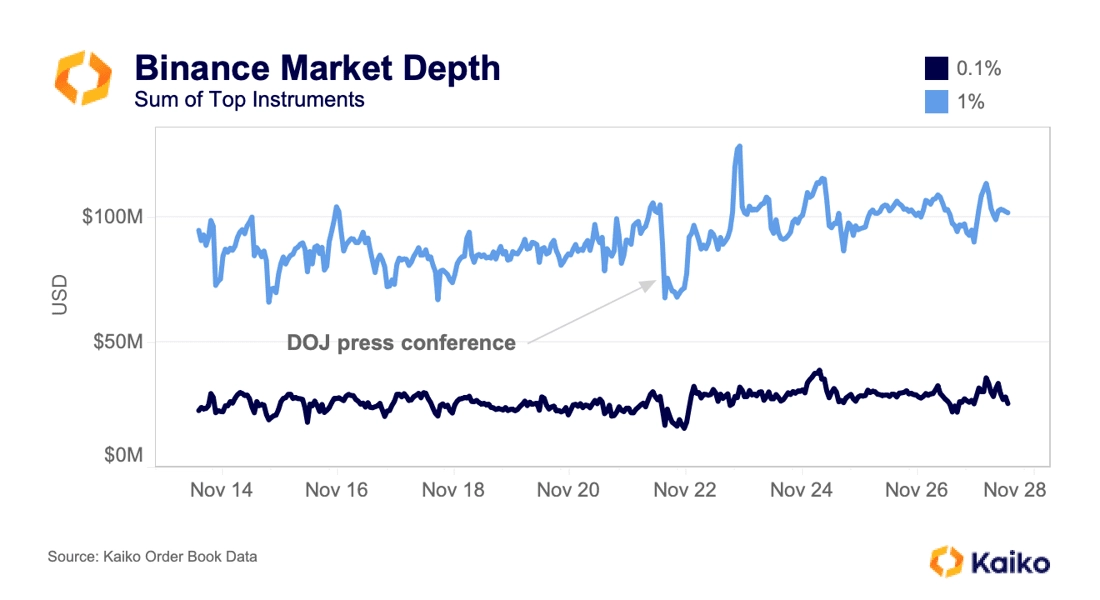
Market depth for top traded instruments on Binance initially dropped ~25%, but soon recovered to prior-levels, at about $100mn.
When looking at market share, we see a slightly different story. Since the start of the year, Binance has lost considerable market share to other exchanges. As of yesterday, its market share was just 46%, a steep drop from more than 70% at the start of 2023.
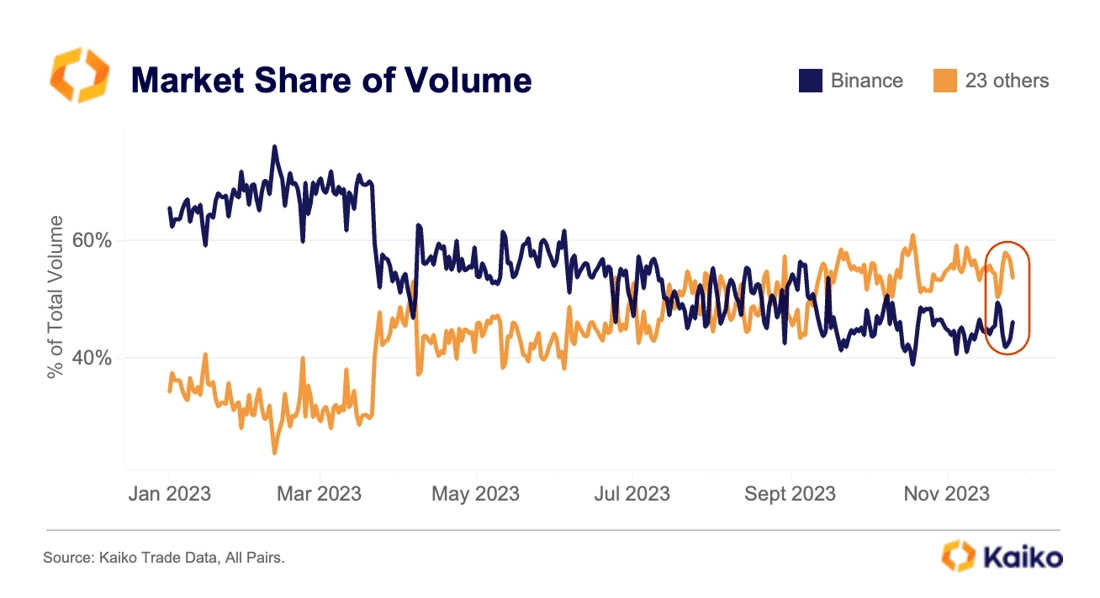
Market share first dipped consistently below 50% in early September due to changes in Binance’s zero-fee promotions. In the immediate aftermath of the settlement, market share dipped from 49% to 41%, but then recovered to 46%.
Binance’s native BNB token was volatile after news of the settlement broke, dropping by 6.8%, and has remained steady at around $230 since.
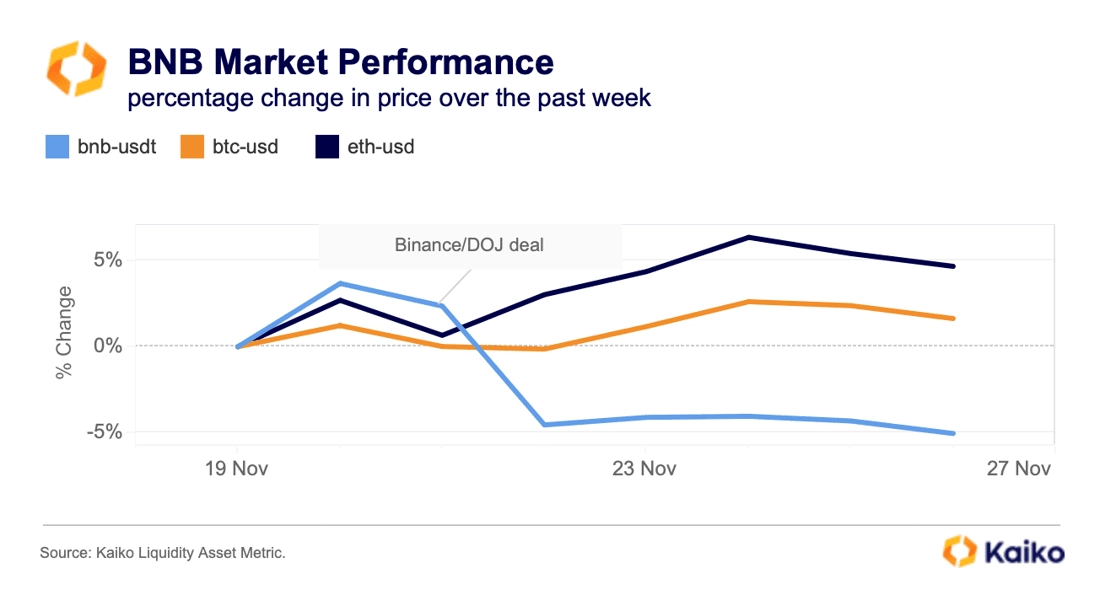
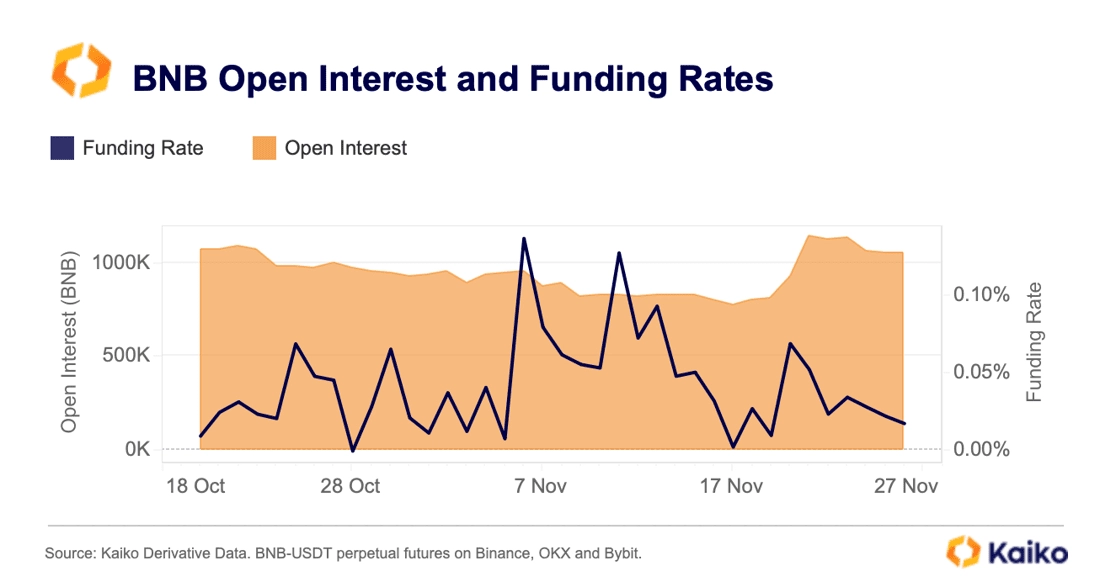
BNB trade volume spiked to $1.6bn, its highest level since the FTX collapse. Open interest was also volatile, rising by 23% between November 20-21, before dropping by 6.6% in the following days. However, while funding rates declined, they remained slightly positive to neutral suggesting both sellers and buyers were active.
Ultimately, Binance emerged mostly intact save for a large fine, the loss of its CEO, and ongoing monitoring. We will be closely observing the exchange’s market share over the coming weeks to understand the true impact.
Data Points
PYTH token surges as Solana ecosystem remains hot.
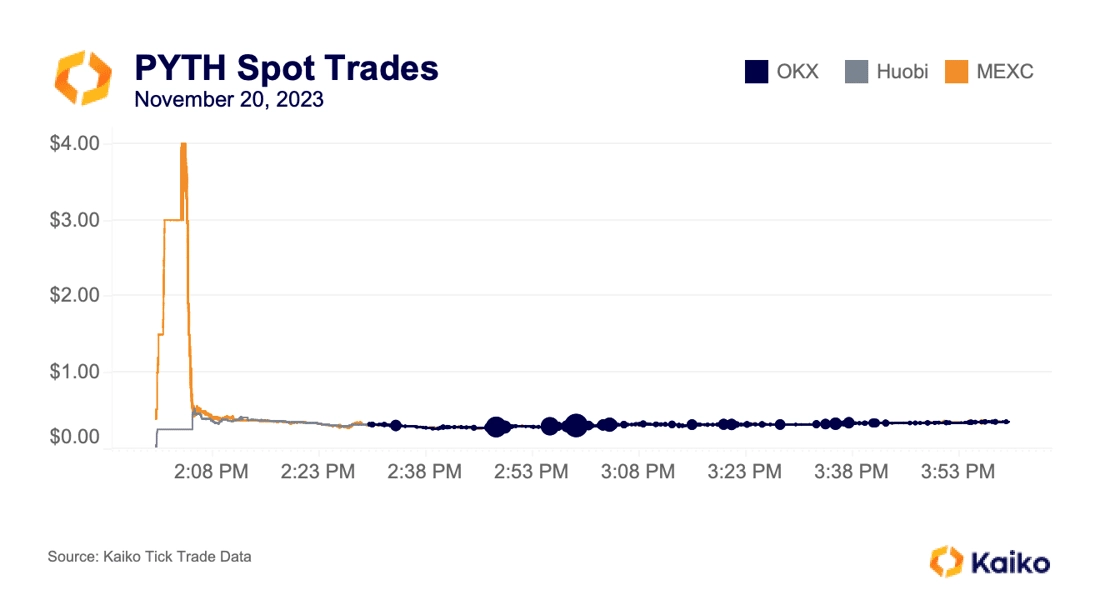
Oracle provider Pyth released its long anticipated token in the form of an airdrop to users who had interacted with protocols using Pyth’s feeds. The token is native to the Solana blockchain, though users on many blockchains received the airdrop. Off-chain, the launch had the characteristic price divergences we’ve seen during past token launches via airdrop.
On MEXC, the token’s price hit $4 less than 10 minutes after trading began. At launch, trades on Huobi were taking place between $0.05 and $0.10. However, bigger trades didn’t roll in until the token went live on OKX; these trades are represented by the larger blue dots.
DeFi borrowing rates remain elevated.
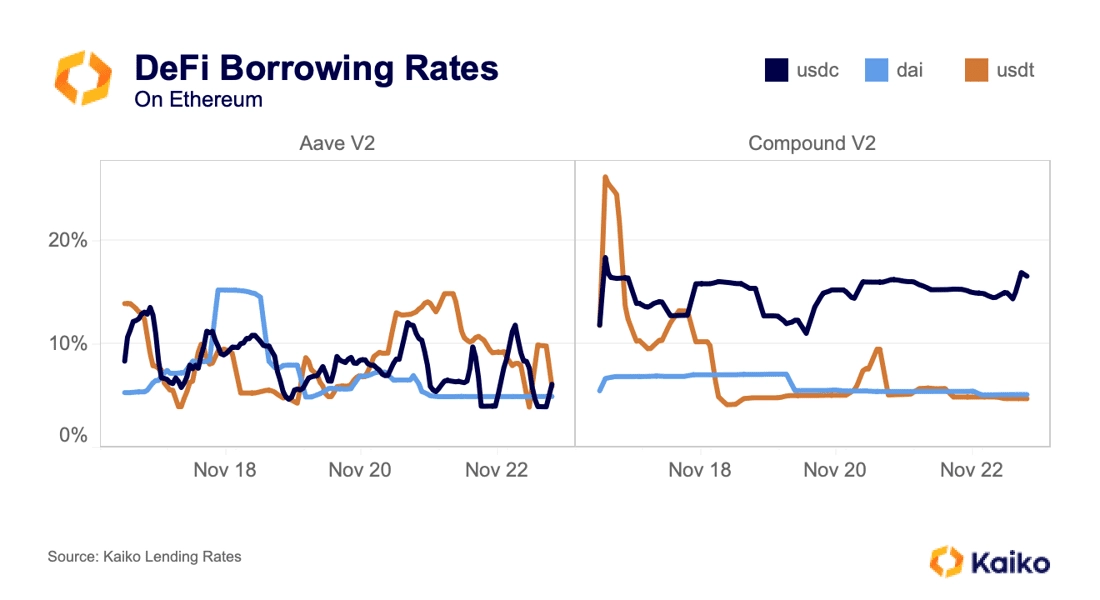
Borrowing rates on Aave V2 and Compound V2 have remained high – about 13% APR on Compound and between 4% and 15% on Aave for USDC – as demand for stablecoins has increased. Rates on Aave have been especially volatile as the utilization rate remains very close to optimal for USDC, DAI, and USDT. The utilization rate describes what percentage of a token deposited into a protocol is being borrowed; when the “optimal” percentage is breached, rates increase rapidly to encourage repayments or deposits, bringing the utilization rate back down.
Utilization rates on the above protocols have trended higher because of increasing borrowing demand for stablecoins in the short term as well as the migration to their respective V3s over the long term.
The end of Bittrex.
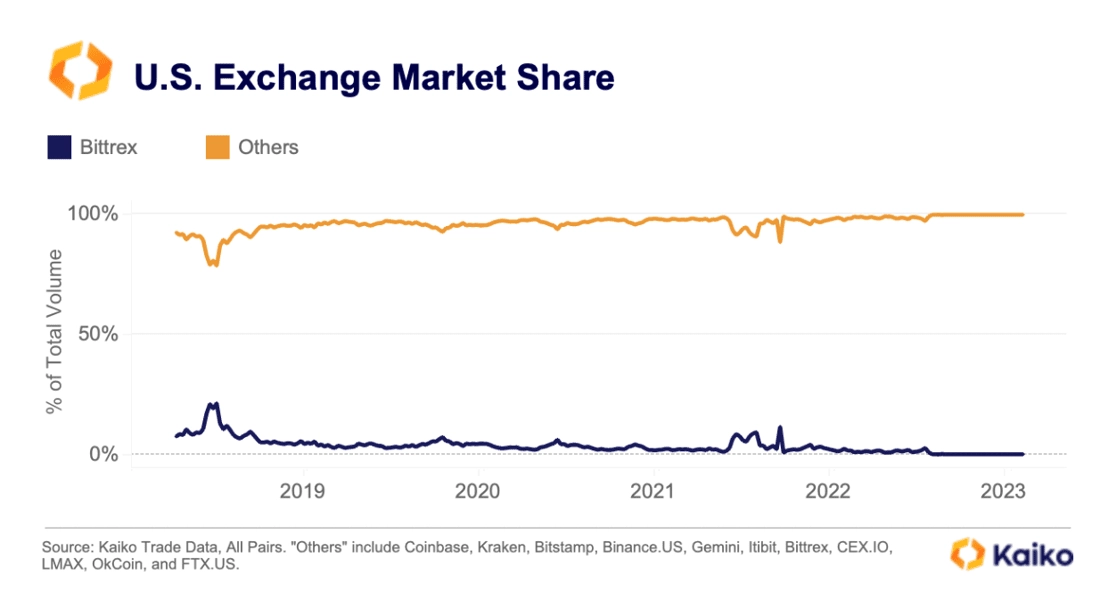
On December 4, Bittrex Global, once of the largest crypto exchanges in the world, will shut down. Bittrex was founded in 2014, making it one of the oldest exchanges. Years ago, it was also one of the largest, on par with exchanges like Coinbase. However, after the 2017 bull market, it failed to maintain its dominance, and since 2018, its market share among other U.S. exchanges has fallen from nearly 20% to less than 1%.
Assets labeled securities are steady despite SEC action.
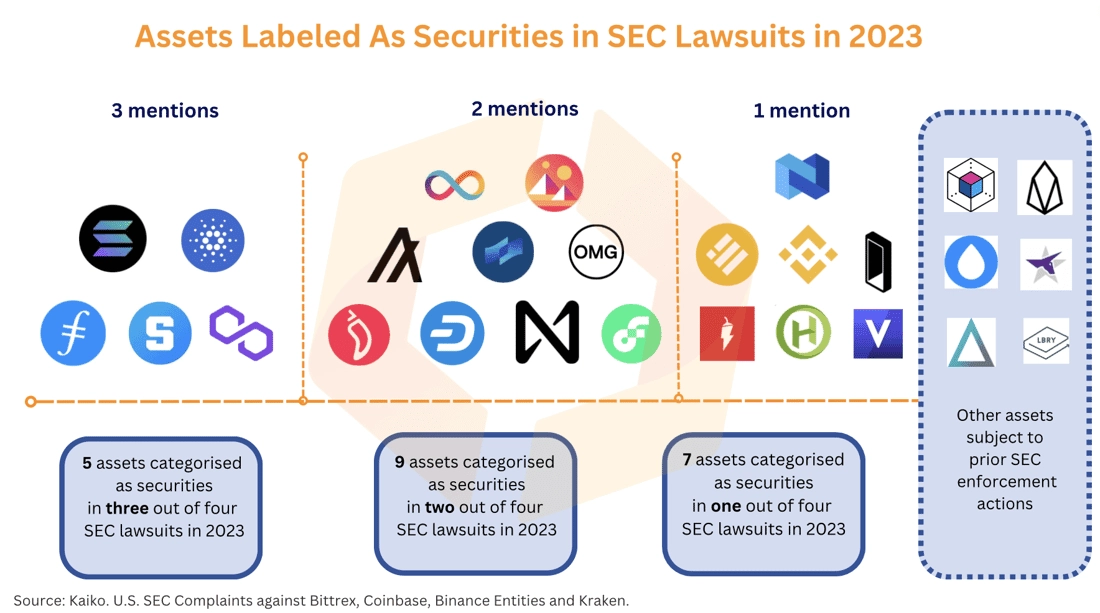
In 2023, the U.S. SEC stepped up its enforcement action against centralized exchanges, suing four platforms for illegally operating as a securities exchange without registering. The agency has also indirectly taken a much wider aim at the crypto industry, explicitly designating several altcoins as securities. Over the past year, nine crypto assets were mentioned twice in the SEC’s complaints against Kraken, Coinbase, Bittrex, and Binance and five were mentioned three times.
How have markets for these assets reacted? The chart below shows an equally weighted simulated portfolio of the five assets most frequently cited by the SEC: SOL, ADA, SAND, FIL and MATIC.
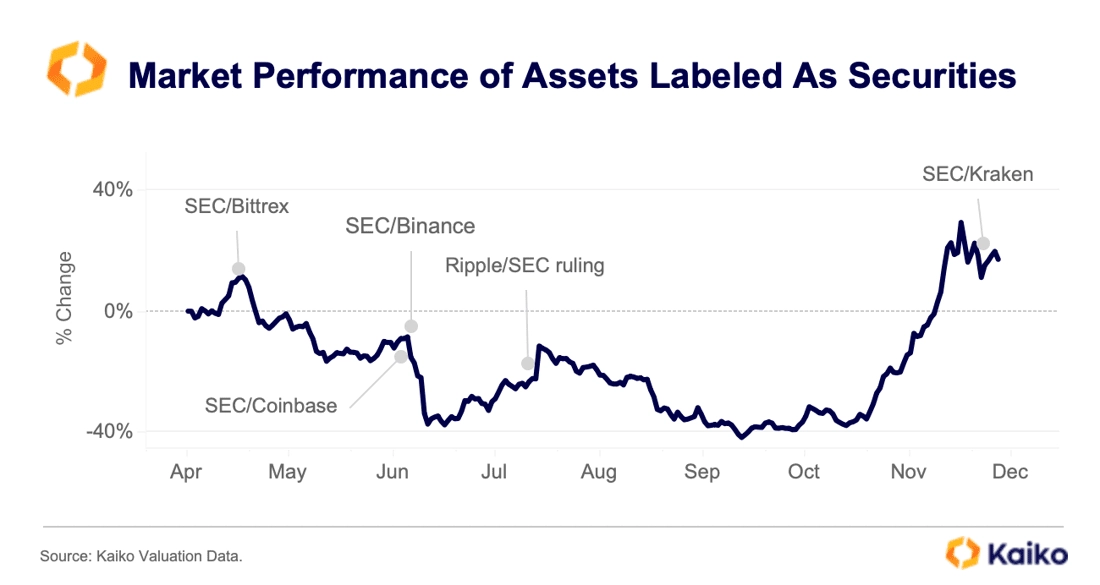
The market reaction following the announcement of the Coinbase and Binance lawsuits on June 5 and 6 was strong and the basket lost 31% of its value. The move was exacerbated by Robinhood and other platforms announcing the delisting of assets and several market makers selling a portion of their altcoin holdings. This led to cascading liquidations in derivatives markets between June 9-11 and a broad altcoin selloff.
Last week, however, prices initially fell after the official announcement of the Binance/DOJ deal, but quickly recovered with BTC briefly hitting a yearly high of $38k. The SEC/Kraken lawsuit did not lead to delistings of any of the assets named, suggesting that confidence in the market has increased following the landmark rulings in the XRP and Grayscale cases.
AI-linked crypto token trade volume takes off.
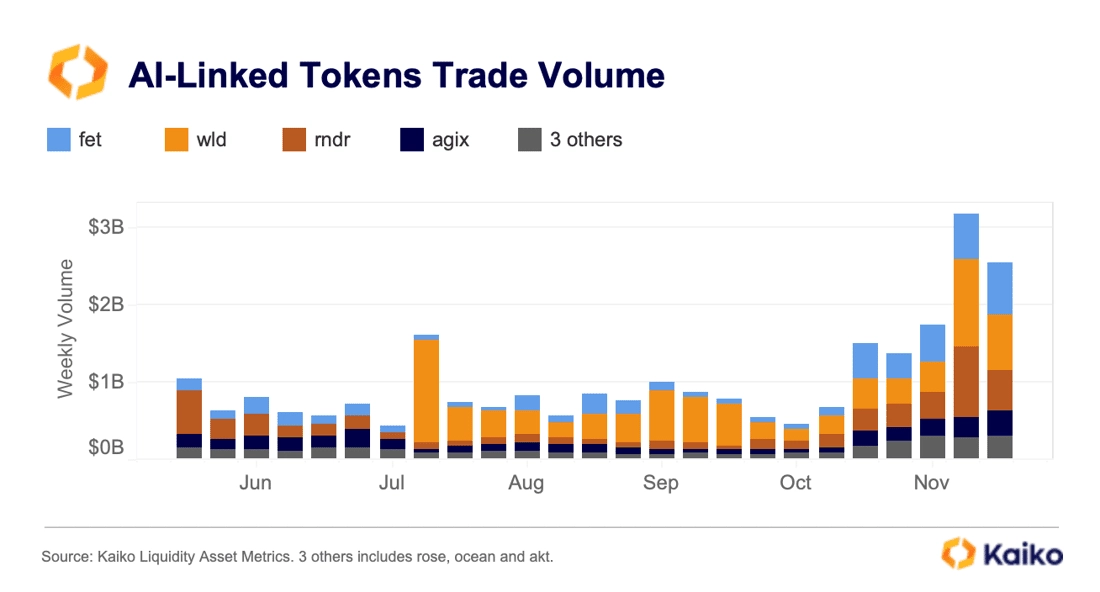
The weekly trade volume of AI tokens reached a multi-month high of over $3bn in early November as global sentiment has improved on the back of better macro conditions and better-than-expected quarterly results by chipmaker Nvidia. The increase was driven by Sam Altman-affiliated Worldcoin (WLD) and Render (RNDR), which accounted for more than half of overall volume in November.
Binance is the largest market for AI-linked tokens. However, its market share has declined significantly from 74% in July to 61% as of last week. By contrast, the share of volume on U.S.-available exchanges has increased. Coinbase has emerged as the second largest AI market and accounts for 9% of global AI tokens volumes, up from just 1% in July.
Bitcoin is less correlated to altcoins in 2023.
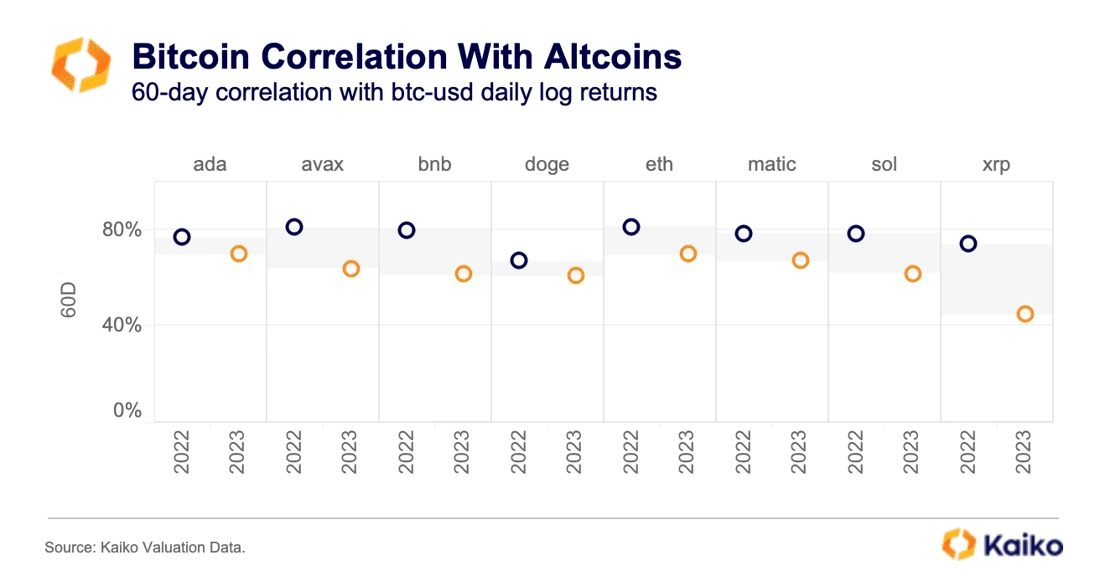
Bitcoin’s appeal as a portfolio diversifier has increased this year because it has de-correlated with traditional assets while posting significant returns. XRP and BNB have registered the largest drop in correlation with BTC while DOGE and ADA have remained mostly correlated. Bitcoin has been outperforming most altcoins over the past few months, attracting institutional inflows on rising enthusiasm around a potential spot ETF approval. While altcoins have been lagging behind, they have gained some traction in November as global risk sentiment improved.



More Data blogs from Kaiko
![]() REPORT: The Verticalization Thesis: How Blockchain Revenue Models Are Evolving
16/07/2026
Data BlogThis report provides an overview of the evolving business model of blockchain networks. We analyze incumbents and newcomers, showing how each of them leverages verticalization differently to answer a simple question: How is the business model of blockchain networks evolving?
![]() REPORT: Crypto Exchanges are Building Financial Super Apps for the Next Billion Users
15/07/2026
Data BlogThis report examines how leading crypto exchanges are evolving from trading venues into integrated financial platforms spanning trading, yield, payments, custody, and collateral. Using a four-layer framework, it explores how liquidity, retained balances, onchain payments, and institutional collateral rails are reshaping exchange competition.
![]() REPORT: Measuring Risk in Crypto Options
11/06/2026
Data BlogIn this report, Kaiko and MerQube analyze how crypto-native and ETF Bitcoin options priced risk differently across two parallel markets in 2025.