The Agora by Kaiko returns to Cannes on April 13, 2027



72% of ETH Liquidity is Concentrated on 5 Exchanges
29/05/2023

Welcome to the data blog
Bitcoin gained some ground early on Monday as U.S. lawmakers reached a debt ceiling deal in principle. Hong Kong confirmed it will allow retail traders to trade certain crypto assets starting June while the Digital Currency Group (DCG) closed its trade execution and prime brokerage units, citing bear market and regulatory uncertainty. In this weeks Data Debrief, we explore:
Trend of the Week
72% of ETH liquidity is concentrated on 5 exchanges.

Since the collapse of FTX last year, there has been little good news on the liquidity front for crypto assets. The shutdown of the Signet and SEN fiat settlement networks in the US severely impacted market makers operational efficiency. This can be seen in 2% market depth for ETH, which dipped in March and has failed to recover to pre-FTX levels. However, .1% depth, which measures liquidity immediately around the mid price, is back above pre-FTX levels as market makers become more comfortable offering liquidity again around a tight range.
Overall, order book liquidity has become very concentrated on only a few exchanges since the collapse of FTX. 72% of ETH market depth exists on just 5 exchanges: Binance, Bitfinex, OKX, Coinbase and Kraken. All other exchanges (41) account for just 28% of market depth. Before FTX collapsed, the exchange and U.S. counterpart accounted for a high of nearly 40%.

While liquidity is becoming more concentrated across a handful of exchanges, it is also moving away from the U.S in the last year. The share of market depth on U.S-available exchanges is at around 40%, down from a high of 54% hit right before the Terra collapse last May. Global exchanges are benefiting from the regulatory crackdown, attracting market makers that don’t want to get caught up in the uncertainty.

Going forward, we could expect a continued consolidation of liquidity on just a handful of exchanges for all assets, not just ETH, as the exchange space struggles to attract market makers amid an ongoing bear market.
This analysis was powered by Asset Metrics.
Price
Stablecoins show little volatility amid debt ceiling drama.

The two largest stablecoins by market cap closed the week trading at a slight premium as the U.S. debt ceiling drama moved closer to a resolution. Interestingly, while stablecoins were heavily impacted by spillovers from the regional banking crisis, both USDT and USDC saw little to no volatility over the past two weeks, despite the ongoing debt ceiling drama. This suggests that a U.S. default was not in the markets’ base case and mirrors a muted reaction in equity markets, with the Nasdaq up 8% this month amid booming AI-related stocks.
It is notable however that, USDT and USDC have increasingly been trading in tandem during periods of market stress. Both stablecoins rose above $1 earlier this month when Binance temporarily halted withdrawals for BTC due to network congestion issues. This suggests that USDC could have recovered some safe-haven appeal as U.S. banking troubles ebbed.
CRV and SNX lead DeFi “blue chips” this year.”

New rollouts have propelled Curve DAO (CRV) and Synthetix Network (SNX) to be the best performers amongst older Ethereum DeFi stalwarts. CRV has been boosted by the release of crvUSD, a new stablecoin utilizing a new collateral and liquidation method; Staked Frax ETH (sfrxETH) is the first collateral asset, with more to be added soon. Additionally, updates to its TriCrypto pool could soon help Curve capture some of Uniswap’s volume market share.
Synthetix, meanwhile, has rallied as new trading incentives on Optimism helped propel its derivatives trading exchange Kwenta to become one of the largest decentralized derivatives exchanges by volume. Uniswap’s token UNI is flat this year despite the exchange expanding to new chains and maintaining its dominance on Ethereum. Maker DAO (MKR) has also struggled amidst debates about the future of the protocol.
Derivatives
BTC rally driven by bullish bets in perpetual futures.

BTC rallied roughly 3% overnight and it looks as if a large portion of that was driven by movements in the perpetual futures market. Since yesterday, over $250mn worth of new BTC perpetual futures contracts were opened, as measured by open interest. This surge of new money looks to be biased long, as funding rates indicate the directionality of the new bets being placed. Funding rates have been positive for the last week, and moved to their most positive overnight as the majority of the new contracts opened were long positions, driving rates higher.
Macro
Bitcoin gains ground despite worsening liquidity outlook.

Bitcoin rose above $28k early on Monday as the U.S. avoided a disorderly debt ceiling episode. While this could have a short-term positive impact on markets, the outlook for liquidity has worsened. Signs that U.S. inflation is accelerating again, combined with relatively robust corporate earnings and a tight labor market, pushed the likelihood of an 11th consecutive rate hike in June to 55% last week, up from 17% a week earlier.
Furthermore, after a deal is reached, the U.S. Treasury is expected to step up debt issuance to replenish its cash balance at the Fed – the so-called Treasury General Account (TGA). The TGA hit its lowest level since 2017 last week as the U.S. has been spending its funds at the Fed to avoid issuing new debt after the ceiling of $31.4tn was reached on Jan 19.
Replenishing the TGA will effectively remove liquidity from the market exacerbating the impact of the ongoing Fed’s balance sheet reduction (quantitative tightening ) which already drains up to $95bn per month.
Bitcoin’s correlation with Chinese equites increases.

The correlation between BTC and Chinese equities (CSI 300) has strengthened this year, although it remains relatively low at approximately 20%. Interestingly, the correlation between BTC and US equity markets has decreased, reaching a multi-year low in April. It is worth noting that crypto is much less integrated in the Chinese financial system relative to the U.S. mainly due to China’s strict stance on cryptocurrencies in recent years. This trend suggests that the regulatory and economic reopening in China is increasingly influencing crypto market sentiment.
Data Used in this Analysis
More Data Blogs from kaiko
![]() REPORT: The Verticalization Thesis: How Blockchain Revenue Models Are Evolving
REPORT: The Verticalization Thesis: How Blockchain Revenue Models Are Evolving16/07/2026
Data BlogThis report provides an overview of the evolving business model of blockchain networks. We analyze incumbents and newcomers, showing how each of them leverages verticalization differently to answer a simple question: How is the business model of blockchain networks evolving?
![]() REPORT: Crypto Exchanges are Building Financial Super Apps for the Next Billion Users
REPORT: Crypto Exchanges are Building Financial Super Apps for the Next Billion Users15/07/2026
Data BlogThis report examines how leading crypto exchanges are evolving from trading venues into integrated financial platforms spanning trading, yield, payments, custody, and collateral. Using a four-layer framework, it explores how liquidity, retained balances, onchain payments, and institutional collateral rails are reshaping exchange competition.
![]() REPORT: Measuring Risk in Crypto Options
REPORT: Measuring Risk in Crypto Options11/06/2026
Data BlogIn this report, Kaiko and MerQube analyze how crypto-native and ETF Bitcoin options priced risk differently across two parallel markets in 2025.
![]() REPORT: The State of the European Crypto Market 2026
REPORT: The State of the European Crypto Market 202609/06/2026
Data BlogThis report examines how European crypto markets transformed regulatory clarity into moderate but consistent growth during 2025-2026, analyzing the mechanisms through which MiCA’s implementation, exchange competition dynamics, and liquidity improvements compounded across the market.
![]() Index in Focus: Inside Out Canton, Ecosystem And Coin
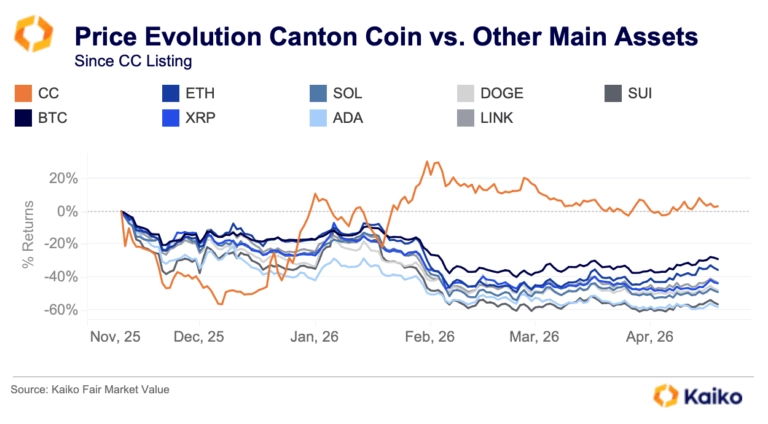
Index in Focus: Inside Out Canton, Ecosystem And Coin07/05/2026
Data Blog21shares, one of the world’s leading issuers of crypto exchange-traded funds (ETFs), announced the launch of
the 21shares Canton Network ETF (Ticker: TCAN). The fund is the first U.S. ETF designed to offer investors
direct exposure to the Canton Coin (CC), the native utility token of the Canton Network.![]() Digital Asset Snapshot: 2026 Rally, ETF Inflows, & Positioning Shifts
Digital Asset Snapshot: 2026 Rally, ETF Inflows, & Positioning Shifts06/01/2026
Data BlogWelcome back to our comprehensive weekly coverage of price action and volatility, trading volumes and market structure (orderbook depth/spreads), derivatives markets (open interest, funding rates, long/short positioning, term structure/basis), institutional flows (Bitcoin ETFs, stablecoin supply across chains), and DeFi credit markets.