As capital markets move onchain, trusted data has become essential to connecting traditional market activity with the same activity onchain. Smart contracts can replicate the logic of traditional financial agreements, automatically triggering margin calls or settling transactions, but they still need trusted market data to determine when to do so.
That challenge, however, is not new for financial services; during a recent discussion at The Agora, Lance Uggla, former CEO of IHS Markit, drew a parallel between today’s onchain capital markets and the early days of OTC derivatives. At the time, derivatives markets had no trusted, independent pricing data, making it difficult for firms to value or settle contracts. Lance pointed to Totem, a service acquired and developed by IHS Markit to solve this problem.
As Lance explained, “What happened in the derivatives market was the need for an independent pricing service, and the service we created was called Totem. The service built the volatility surface, including all the strikes and all terms, in and out of the money. Participants had to be knowledgeable to price the entire surface, and if they failed on any point, they were rejected without the data needed for their risk and compliance for mark-to-market (MTM). There was no derivative contract in the world and no point on a vol surface that wasn’t covered, and that data set allowed the banks to MTM properly and for IHS Markit to more accurately price the acquired positions of the buyside.”
In practice, Totem became a definitive form of consensus data infrastructure for traditional derivatives markets. It allowed participants to contribute pricing data and receive aggregated market data in return, to benchmark their marks against the broader market, and support valuation, risk management, and settlement. This is the same market infrastructure challenge we see today onchain. Tokenized assets, stablecoins, tokenized treasuries, and smart-contract financial agreements are now commonplace, but still need trusted data to function.
Kaiko CEO Ambre Soubiran reflected on this market demand as the reason for launching Kaiko Data Infrastructure, saying, “Now that we’re using blockchain as an infrastructure [for financial markets] and we’re creating smart contracts that replicate traditional financial contracts, you need to have the exact data point that you want at that point in time, provided by someone you can trust. And I think that’s a big shift. The blockchain technology works, smart contract logic works, tokenized assets are coming, regulated stablecoins, cash equivalents, tokenized treasuries, all of that is coming to the blockchain. In my opinion, though, the critical missing piece of market infrastructure is the real-time data infrastructure to feed all those traditional financial contracts with traditional market data. And that’s really when I draw the parallel with IHS Markit and what we’re trying to do [with Kaiko’s data infrastructure offering]: it [Totem] was really this critical market data angle feeding into contracts, enabling trading and execution.”
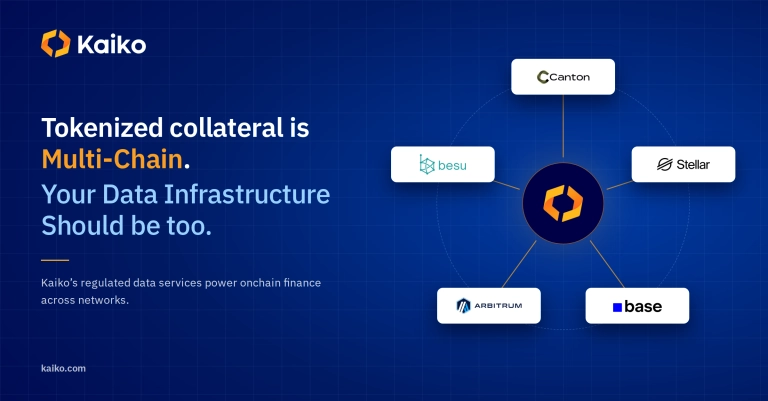
Kaiko Data Infrastructure plays a critical role in the ongoing adoption of blockchain technology for capital market use cases. Its Data On-Ramp solution delivers institutional-grade market data, including reference rates, foreign exchange rates, and corporate action data. Through partnerships with the likes of Bloomberg and S&P DJI, all data retains the same trusted brand names and auditability as offchain equivalents.
Kaiko is helping build the data backbone for onchain capital markets, just as trusted pricing infrastructure helped unlock the growth of OTC derivatives. Learn more about Kaiko Data Infrastructure solutions here.