S&P Global Leads Strategic Investment in Kaiko, Extending Series B to $110 Million



Distributing IP Products on Public Blockchains: The Distribution Challenge.
For institutional-grade finance to become a reality onchain, it’s critical to be able to understand who is actually responsible for the data on which onchain applications make their decisions.
In conventional capital markets, the responsibility has long been clear. Licensed data providers supply information under contract with well-documented methodologies and audited processes. If something goes wrong, there is an entity to hold accountable, so the entire architecture of institutional trust is built on this. Onchain, the trusted foundation is less established.
Transparency is not the same as trust
A common misunderstanding with onchain data infrastructure is the conflation of visibility and validity. Just because blockchains are open and immutable, it does not mean that the data written there is correct, official, or current.
Stephanie Rowton of S&P Global mentioned this at The Agora recently:
“People conflate transparency onchain with trust onchain. Just because data is onchain, it doesn’t necessarily mean it’s correct, it’s official, it’s up to speed. We need to educate our partners on the DeFi side as to why you should be working with official, licensed S&P data, why it’s going to be less risk.”
While an onchain price feed may be visible and functional, for regulated onchain use cases, that’s not enough. It’s essential to know the organization behind the data and hold it accountable for data errors and SLAs on uptime.
The need for institutional-grade licensed data products onchain is now clear, but how data providers make them available in a way that preserves intellectual property and usage entitlement is less so.
Solving the IP problem at scale
The speaker’s observation points to a specific infrastructure gap sitting between the data providers who own the data and the smart contracts and onchain applications that need to consume it.
Global data providers are not experts in building oracle infrastructure. Their expertise is in the data itself: the methodologies, the licensing frameworks, and the institutional trust built over decades of operating at the heart of capital markets. But they need to put their data onchain, reliably and at speed, without compromising any of the IP controls and contractual obligations that govern it in traditional markets.
That’s where a governed intermediary like Kaiko comes in. Acting as an infrastructure layer, Kaiko handles the complexity of taking third-party institutional data and delivering it onchain via dedicated institutional-grade oracles. The contracting remains directly with data providers, with Kaiko holding and enforcing the licensing and entitlement framework on their behalf, ensuring that what arrives in a smart contract is precisely what the consumer is contracted for.
A trusted intermediary is the critical piece for regulated markets onchain. A governed layer that holds the contractual relationships, enforces entitlements, and puts its name on the data it delivers is what makes institutional-grade data possible onchain.
Watch the full session at The Agora here.
Learn more about how Kaiko Data On-Ramp delivers institutional-grade data onchain with full IP protection and licensing compliance at onchain.kaiko.com.
More From Kaiko
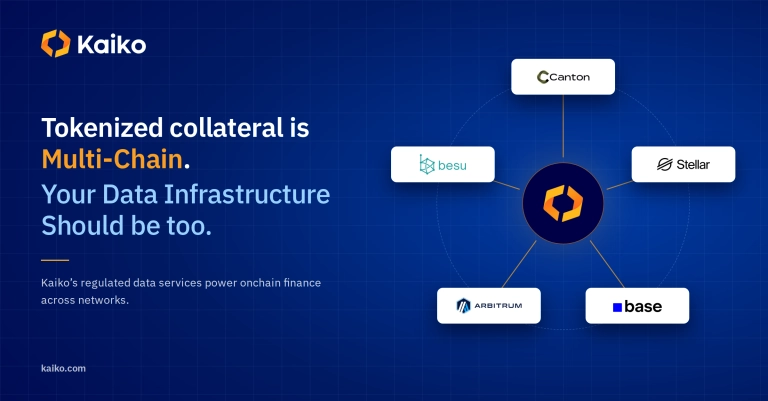
![]() Tokenized Collateral Is Multi-Chain, So Your Data Infrastructure Should Be Too.
Tokenized Collateral Is Multi-Chain, So Your Data Infrastructure Should Be Too.19/08/2026
PerspectivesAs tokenized real-world assets become collateral across public and private blockchains, institutions need reliable data wherever those assets sit. This article explores the multi-chain infrastructure powering tokenized markets and how Kaiko delivers regulated, trusted reference data across networks, helping create a consistent source of truth for pricing, settlement, and collateral management.
![]() Deep Dive: Tokenization
Deep Dive: Tokenization17/07/2026
PerspectivesLearn more about tokenization infrastructure, how real-world assets are brought on-chain, and the data standards required for successful institutional adoption.
![]() A New Economic Model for Oracle Services on Canton
A New Economic Model for Oracle Services on Canton23/06/2026
PerspectivesWe explore the new economic model for oracle services on Canton, where CIP-0104 ties app rewards to real network traffic rather than activity markers, improving cost efficiency at scale.
![]() The Future of Onchain Finance with Lance Uggla
The Future of Onchain Finance with Lance Uggla18/06/2026
PerspectivesDrawing on the rise of OTC derivatives, we explore why trusted, independent pricing data is the missing market infrastructure piece for tokenized assets and onchain capital markets.
![]() How S&P DJI and Kaiko are bringing IP-protected market data onchain
How S&P DJI and Kaiko are bringing IP-protected market data onchain16/06/2026
PerspectivesWe discuss how S&P DJI and Kaiko are bringing IP-protected market data onchain, treating data as a financial asset with controls and monetization built in.
![]() Institutional finance on the blockchain: A future in progress
Institutional finance on the blockchain: A future in progress09/06/2026
PerspectivesWe explore how trusted data partnerships are bridging onchain and offchain markets for institutional use.